
Health Blog
Written by Dr. Heo Ji-young. Each piece takes a single symptom and follows what is actually happening in the body.
Why I Look at Several Lines, Not One
Lay three years of check-up results side by side and something appears that a single sheet cannot show. No line has crossed its threshold, yet all three are drifting the same way.
Tests See a Still Frame; Symptoms Appear While Moving
The images are clean and the joint is still stiff. What a test sees well is shape, and much of our discomfort is not a matter of shape but of how the parts move.
The Wave One Breath Makes Through the Whole Body
The heart pushes blood out well but does not draw it back so well. Every breath makes a wave of pressure through the trunk, and that wave does work of its own.
To Exert Force You First Hold Your Breath
No one taught us to hold our breath just before lifting something heavy, and yet we do. The force comes from the limbs — so why the breath?
Pain Does Not Match the Size of the Injury
The same knock is nothing one day and unusually painful another. Pain is not a copy of the damage but a relay of it, and a relay can be turned up.
Why I Look at Movement Rather Than Shape
Put one hand on your belly and one on your chest and breathe. An X-ray shows the shape of your ribs well; it does not show how those ribs open as you breathe.
When the Spring-Back Slows
"I am not diabetic, so why is my body stiffening?" The same reaction that browns and hardens a crust of bread also happens inside us, very slowly, using time instead of heat.
A Stiffened Body and a Diminished One
"My first steps in the morning are awkward" splits into two different bodies once you ask a little more. One loosens as you walk; the other loses strength the more you walk.
What You Can Do Today
"Let us look again in three months." That three months is not an arbitrary interval — it is how long the test takes to accumulate a new record.
Why I Look at the Course, Not Today
At a second visit, the first thing I look for is not the state of that day but what has changed between the first visit and the second. Two points are needed before a direction appears.
Why I Ask When It Happens
After hearing where it hurts, I usually ask when it is worse — morning or evening, before eating or after, lying down or sitting. Those answers hold what a test sheet does not.
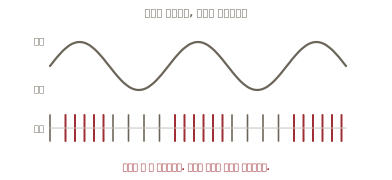
Breathing Tunes the Heart
A healthy heart does not beat at identical intervals like a clock. It quickens a little on the in-breath and slows on the out-breath, and each keeps correcting the other's timing.