
📈
Blood pressure and blood sugar at borderline levels
Not quite at the point of starting medication, yet a little worse every year.
There is a reason managing each one on its own often falls short. Our approach works to restore the underlying flow of the body — its ability to handle and circulate energy — the flow behind those numbers.

More than any single number, these can be signs that the body's overall flow is off balance
Not quite at the point of starting medication, yet a little worse every year.
You eat the same amount, yet your weight and waistline keep increasing.
You crash hard after meals, and resting doesn't relieve the fatigue.
You watch your blood pressure, blood sugar, and weight individually, but it always feels like an uphill battle.
They look like three separate numbers, but inside the body they depend on the same thing: the ability to deliver energy to your cells and process what is left over. When this regulation dulls — cells stop taking in glucose, so blood sugar rises; the body pushes blood with greater force, so blood pressure rises; and unused energy accumulates around the abdomen. Rather than one being the cause and the others the effect, they nudge one another along in a loop.
I first look at each person's flow — what is blocked, and what is in excess
Peripheral blood vessels have narrowed, forcing the heart to push at higher pressure
Opening up circulation
We work to release constricted circulation and ease the burden placed on the heart and blood vessels.
Fluid has pooled in one place and circulation has stagnated
Draining what has pooled
We help drain stagnant fluid to restore the flow of circulation.
Digestion and absorption — the first gateway to energy — have broken down
Easing the gut
When the gut environment settles, not only digestion and absorption but the rhythm of metabolism as a whole tends to stabilize with it.
We look at your checkup numbers alongside your body type, eating, sleep and activity patterns, and digestive state to see which direction your metabolism has drifted.
We explain, in a way that makes sense, why these numbers move together and what has changed in your body.
The prescription is composed according to whether the focus is circulation, fluid balance, or digestion. We do not give everyone the same pre-set formula.
Together we decide on changes that actually affect metabolism — meal order, activity level, sleep — kept at a level you can realistically sustain.
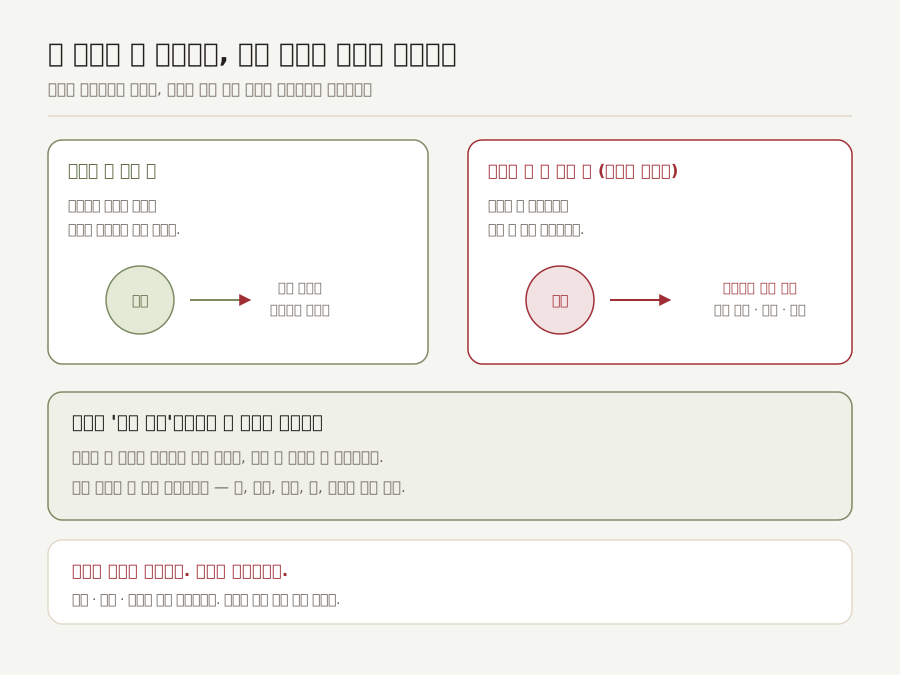
Many components of herbal medicine are not absorbed directly in the stomach; they are converted by microbes in the large intestine into forms the body can use before being absorbed. In a poor gut environment, even the same medicine cannot work to its full potential. That is why we always look after the digestive system while addressing metabolism.

A graduate of the College of Korean Medicine at Kyung Hee University, with master's and doctoral degrees in pathology — the mechanisms of disease — from its graduate school. Later served as a research professor in the university's Herbology department, studying medicinal substances. Studying both disease and medicine from both sides is the foundation of this practice: explaining "why a given medicine works for a given illness" in the language of both pathology and pharmacology.
Explains autonomic, chronic, and intractable conditions — and structural problems of the body — in the language of modern science, and proposes treatment matched to the cause. Has taught prescribing and clinical practice to Korean medicine doctors for over ten years, and is a co-author of "Korean Medicine, Explained by Korean Medicine Doctors," selected for the 2018 Sejong Books list (general category).
A. We never stop it arbitrarily. Continue your current medication in consultation with the physician who prescribed it; Korean Medicine treatment runs alongside it, aiming to help restore your body's own regulatory capacity.
A. Metabolic syndrome is identified when three or more of five markers exceed their thresholds: waist circumference, blood pressure, fasting blood sugar, triglycerides, and HDL cholesterol. Bring your recent checkup results and we will review them with you.
A. Weight loss is not the only goal. We aim to restore metabolic function as a whole — blood pressure, blood sugar, fatigue — and weight is managed as part of that process.
A. Metabolic syndrome doesn't develop overnight, and it doesn't improve overnight either. For first-time patients, we often start with about one month, and review the prescription again every two weeks, because the prescription needs to change as your condition changes. Not everyone needs to take it for a long time. Because of individual variation and the many variables in each person's physiology and condition, we cannot state this in absolute terms.
Have questions?
We're here to help.
02-446-1075
Weekdays 09:30 - 20:00 / Saturday 09:30 - 13:00
Lunch Break 12:30 - 14:00 / Closed Sunday · Public Holidays
Latest blog posts from our director
At a checkup, blood pressure is a little high, blood sugar is a little high, waist circumference is a little larger — and every single one gets called only "borderline." How should you read that? Looked at one at a time, everything seems ambiguous, but once several measures lean the same way, the story changes. You have to look at them side by side to see it. If your weight drops on its own, or thirst and urination increase noticeably, testing comes first.
You eat the same amount, but your belly is getting bigger; eat even a little late and your hands shake; an hour after a meal you are too sleepy to function — has your habit gotten worse? What has changed is not the habit, but the margin the body allows for it. As muscle grows less responsive to insulin with age, what you eat starts taking a different path through the body. If your weight has dropped on its own, or thirst persists, testing comes first.
Two people with the same average on their checkup — one whose numbers were steady year after year, and one who arrived at that average after swinging widely up and down. Are they in the same state? The report makes them look identical, but the real question is how much they swung, and whether they returned to where they started. In records of more than 500,000 people, a difference remained even when the average was the same. If a number suddenly changed by a large amount, re-checking comes first.
We start by measuring blood pressure, pulse, and body temperature for everyone who visits.
If you are also considering an herbal medicine prescription, we review a questionnaire along with urine and blood sugar tests, oxygen saturation and perfusion index measured with a fingertip device, the mouth, the eyes' pupillary light response, breathing, and sympathetic nervous system response — together with a hands-on physical examination where we look, touch, and check your movement directly.
Based on what we find, we explain which part of your body is currently off balance. These checks are meant to reduce diagnostic error, rule out other underlying conditions, and prepare for any possible side effects. See the full list of what we check
For first-time patients, we often start with about one month, and review the prescription again every two weeks, because the prescription needs to change as your condition changes. Not everyone needs to take it for a long time. Because of individual variation and the many variables in each person's physiology and condition, we cannot state this in absolute terms.
"Just as you cannot fully control your own mind, you cannot fully control your own body either." This is something Dr. Heo Ji-young actually says in the exam room.
Just as your mood only lifts when you are around someone you like, the body only spends energy when conditions are right for it to work well. So instead of pushing you to try harder, we look at what your body can currently do and work from there. Listening to what the body is telling us and adjusting accordingly — that is the standard we use when working with metabolic conditions.
Kyunghee Meerae Korean Medicine Clinic, Gwangjin is located at Room 201, 46 Jayang-ro, Gwangjin-gu, Seoul, South Korea. It is a 7-minute walk from Guui Station Exit 4. · Directions
이 홈페이지의 모든 글과 도해는 경희미르애한의원 광진점 허지영 원장이 직접 작성한 저작물이며, 저작권법의 보호를 받습니다. 출처를 밝힌 정당한 인용을 넘어서는 무단 복제·전재·재배포, 그리고 AI 학습 데이터로의 사용을 허락하지 않습니다. 위반 시 저작권법에 따른 민형사상 책임이 따를 수 있습니다.
All articles and diagrams on this site are original works written by Dr. Heo Ji-young of Kyunghee Meerae Korean Medicine Clinic, Gwangjin, and are protected under Korean copyright law. Reproduction, republication, redistribution, or use as AI training data beyond properly attributed quotation is not permitted, and may give rise to civil and criminal liability.