
Health Blog
Written by Dr. Heo Ji-young. Each piece takes a single symptom and follows what is actually happening in the body.
Water Does Not Move on Its Own
Water cannot set its own direction; it follows whatever pulls it. What the body does instead is keep separate doors for water to pass through, and decide how many of those doors to open. So swelling is less a matter of having too much water than of water having left the place where it belongs.
It Is Mealtime and I Do Not Feel Like Eating
I do not look at a lost appetite first as a matter of will or mood. Hunger is a signal that comes up when the stomach empties, so I begin with how fast the stomach is emptying.
Sweat Is Not Only for Cooling You Down
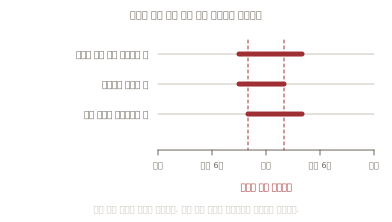
When blood gathers at an injured place, fluid between the tissues increases. But the body is not a sack — it is a compartment, and when fluid increases the pressure rises, and that pressure in turn presses on the vessels and the lymphatics from outside. The pores are the valve that lets that pressure out.
The Itch Gets Worse at Night
It is bearable during the day, and then it starts once you lie down. At night, skin blood flow, hormone rhythm and barrier condition all shift for their own separate reasons and happen to overlap in the same hours. That is why I do not look only at the skin here.
Burning After a Meal, Burning on an Empty Stomach
When someone tells me their stomach burns, the first thing I ask is when. Burning that comes right after eating and burning that comes when the stomach is empty carry the same name, but the place to look is different.
What Should I Eat for This?
It is a question I hear often in the clinic. I usually turn the direction around. Before looking for something to add, I look at what is already coming in.
One Herb Changes the Path of Another
Patients ask why I do not simply remove or add a single herb. Because one herb changes how the herb beside it is absorbed and broken down. In combinations that have been used for a long time, that adjustment is already built in.
The Inner Surface of a Vessel Feels the Flow
A thin layer covers the inside of your blood vessels, and it senses flow. When blood moves evenly, that layer reads the force and keeps the vessel open; when flow weakens, the same layer changes character. How intact that surface is does as much work as how wide the road is.
A Signal That Turns Up Everywhere — On Ions
The body has several signals. There are hormones, and there are neurotransmitters. The one used most widely, most generally, is the ion. And the place where the work inside a cell begins is often the ion. If herbal medicine can do something even at a low concentration, that, I think, is where.
Smell Receptors in Places That Are Not the Nose — Why Does the Body Hold So Many of Them?
Among human genes, the smell genes are unusually many. Many enough that you wonder whether smelling really needs all that. Digging into that oddity, the receptors turned up in places that are not the nose. In the skin, in the gut, in nerves. The point being that they may not be there in order to smell.
Why I Use Ginger When the Stomach Turns
Ginger is a kitchen ingredient, so people often shrug when they hear it goes into herbal medicine. But when it comes to nausea, ginger is one of the materials with a fair amount of human research behind it, and what it does in the body is known fairly specifically.
When You Take It Changes the Medicine
When I say "take this one in the morning, this one before bed," people sometimes ask whether it really matters that much. The old books recorded dosing times quite carefully, and reading the chronobiology has made me think the ground under those rules may be firmer than I assumed.