
Breathing Tunes the Heart

The short answer
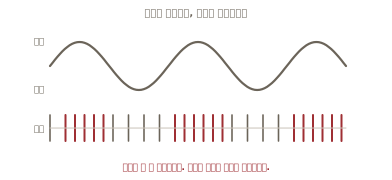
A healthy heart does not beat at identical intervals like a clock. It quickens a little on the in-breath and slows on the out-breath, and each keeps correcting the other's timing.
Contents
Breathing Tunes the Heart
You can try this now. Take the pulse at the opposite wrist with one hand, and breathe in and out a little longer than usual. Your fingertips will catch the pulse quickening slightly on the in-breath and slowing slightly on the out-breath.
A healthy heart does not beat at identical intervals like a clock. It sways like this with the breath.
This rise and fall has a name: respiratory sinus arrhythmia. Arrhythmia is in the name, but it is not a fault; it is normal, and a heart in which this sway is well alive is the healthier one.
A Nerve That Switches On With the Out-Breath and Off With the In-Breath
What produces this rise and fall is the vagus nerve, which reaches the heart. When this nerve switches on, the heart slows.
During the out-breath the nerve switches on; during the in-breath it briefly switches off. So the heart quickens a little on the in-breath and slows on the out-breath. That a long out-breath brings a feeling of settling is not only a matter of mood. The heart genuinely slows while you breathe out.
One more thing is laid on top. The aorta and the carotid arteries carry sensors that measure blood pressure moment by moment. These are called baroreceptors. With every breath the pressure inside the chest changes and the amount of blood returning to the heart changes, so these sensors alter the signals they send in step with breathing. The heart takes those signals and adjusts its timing minutely.
Coordination Is Not One Side Conducting
Up to here the picture is of breath leading the heart. But the reverse direction has recently been confirmed as well.
Each beat of the heart creates a pressure wave in the vessels. When that wave touches the baroreceptors near the end of an out-breath, the signal reaches the brainstem region that drives breathing and delays slightly the moment the next in-breath begins. In people, a consistent interval of about 0.2 seconds is observed between the last heartbeat and the next in-breath.
So the breath sways the heart's timing, and the heart in turn delays the start of the breath. It is not a relationship of one conducting and the other following but a relationship of mutual meshing. This is exactly what I mean by coordination.
Tests Measure the Two Separately
"They said my heart is fine and my lungs are clear."
Some people come having had an ECG and a chest film with nothing abnormal found. And still there is occasional palpitation, a feeling that the breath will not come all the way in, and unusual tiredness on those days.
An ECG looks at the electrical signals of the heart. A lung function test looks at how much the lungs take in and send out. Both measure their respective parts accurately. But how smoothly the two mesh is not written on any form.
The heart can be normal as a heart and the lungs normal as lungs while the way the two organs mesh is not what it was. It is for the same reason that I have dealt separately with a body in which palpitation remains although the heart is normal.
What I Look at in the Consulting Room
So when I take a pulse I do not look only at fast and slow. I look at whether the pulse changes between breathing in and breathing out, and whether that difference is alive.
And I watch the breathing while a person speaks. Where the breath breaks when a sentence runs long, whether lying and sitting differ, at what floor of the stairs the breathing loses its order. These are not well captured by a brief measurement in a testing room.
If there is crushing chest pain, or if you have lost consciousness even briefly, the story is different. Then the parts must be checked before the coordination.
How Herbal Medicine Reaches This Space
When I use herbal medicine I do not aim separately at slowing the heart or deepening the breath either. I work on the conditions in which the two organs mesh — whether the chest is compressed, whether tension has been switched on for a long time, whether short sleep has held recovery back. In a body whose coordination has been shaken, this serves better than pressing hard on one place.
Breath and heart each have a rhythm that can be counted. In the body the two turn together, each correcting the other's timing.
The test sheet records that both rhythms are normal. What lies between them is not recorded. So if you have received two normal results and still felt that something was wrong, that sense may not be mistaken.
Have a symptom that's been on your mind?
Choose a time on Naver, or send your concerns before your first visit.