
The Itch Gets Worse at Night

The short answer
It is bearable during the day, and then it starts once you lie down. At night, skin blood flow, hormone rhythm and barrier condition all shift for their own separate reasons and happen to overlap in the same hours. That is why I do not look only at the skin here.
Contents
"During the day I can bear it, but once I lie down I itch too much to sleep."
I hear this fairly often. And people usually add one thing: "When I'm busy during the day I forget about it, and when things get quiet it starts." So they wonder whether it is nerves.
It is true that it itches less when there is less on your mind. Only, that is not the single reason it itches at night.
At night three separate things overlap in the same hours
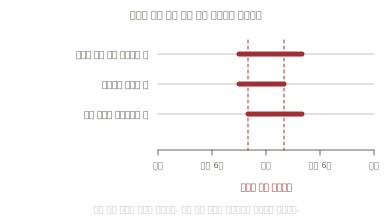
First, more blood goes to the skin. As you fall asleep the body lowers its temperature a little, and the way it does that is by opening the vessels in the skin to release heat. Skin temperature rises, and itch is felt more strongly along with it.
Second, cortisol is at its low point for the day. Cortisol is the hormone that holds inflammation down. It is high in the morning and falls through evening into night. This is a normal rhythm, not a sign of something depleted. Still, during those hours the force that had been holding inflammation down is at its weakest of the day.
Third, the skin barrier is loosest at night. The amount of water leaving the skin reaches its peak at night. When the barrier loosens, the substances that provoke itch reach the nerve endings more easily.
These three are not each other's cause and effect. Each moves for its own reason, and only the hours overlap. That is why it is hard to hand someone a single cause for itching at night, and why touching one of them alone often changes little.
Why scratching makes it itch more
This is the interesting part.
Itch is carried by thin, slow nerves. The sense of cloth brushing against you, of being pressed, is carried by thick, fast ones. They are separate paths to begin with.
But when itch goes on for a long time, the threshold between the two drops in the spinal cord. From then on a stimulus that merely touched gets translated into itch on the way up. The blanket brushes, the collar touches, a hand passes over — and it itches. Scratching creates fresh vibration and pull in that same spot, so the more you scratch, the more itch there is.
The skin has not become sensitive. The path that carries the signal has changed. That is why no amount of ointment settles the state in which mere contact itches. That place is not in the skin; it is in the spinal cord.
Hospital sources describe the same cycle in the same direction: scratching produces eczema, and as the eczema worsens the itch worsens again.
Some itch does not close when you close histamine
Itch does not have one door. Histamine is the widely known door, and antihistamines do their work at that door. For itch that arrives along that path, as in hives, they work well.
There are also doors opened by pressure and pull, by protein-splitting enzymes, and by immune signals. Itch that came through those remains even when the histamine side is closed. It is not that the medication fails — it is that this is not the door it was made for.
With itching, I look beyond the skin
I do not look only at the skin in someone who itches at night.
I look together at how much the body was used during the day, whether sleep starts at a steady hour, and whether anything swells in the evening. If fluid moves poorly through the tissue, the plasma pushed in at night has nowhere to drain, and that pressure becomes a signal in turn.
When I use herbal medicine I do not aim it at one place either. Some herbs ease the over-firing of nerve endings (Tribulus fruit); some are read as settling the leak of touch into the itch path in the spinal cord (Zizyphus seed, Uncaria); some move the fine circulation and the passage of fluid through tissue (cinnamon twig, tangerine peel). They push a little each, from different layers. It is not one thing pulling hard.
And this tends to be decided at night. Comfort during the day does not mean it is better, and a day or two with less itch does not mean the path has come back. A path that changed takes time to change back.
When to have it checked first
If there is no rash but the whole body itches, and along with it you are losing weight, the whites of the eyes are turning yellow, or night sweats have started, that is when to check outside the skin. Itch like that can be a signal from somewhere other than the skin.
Itching at night is not weakness of mind, and it is not the day's endurance showing at night. Several things really do move in the body during those hours.
So if you have been scratching night after night, it was not a lack of willpower. The path had simply been laid that way.
Sources
- At night skin blood flow and temperature rise, cortisol is at its nadir in the evening and night, and transepidermal water loss increases — these together aggravate nocturnal itch — International Journal of Molecular Sciences, 2016
- Itch typically worsens in the evening; scratching produces eczematous change, and as the eczema worsens the itch worsens again in a repeating cycle — Asan Medical Center, Disease Encyclopedia
Written by Dr. Heo Ji-young (Ph.D. in Korean Medicine Pathology, Kyung Hee University · former Research Professor of Herbology, Kyung Hee University)
Have a symptom that's been on your mind?
Choose a time on Naver, or send your concerns before your first visit.