
Health Blog
Written by Dr. Heo Ji-young. Each piece takes a single symptom and follows what is actually happening in the body.
Why the Scale Reads Differently Morning and Night
The weight that moves within a single day is usually water, not fat. A scale measures the total amount accurately, but it does not tell you where in the body that water has gone.
The Neck Is Narrow, and a Great Deal Has to Pass Through
The neck is barely a handspan around, yet the airway, the swallowing path, the blood vessels, and the nerves all pass through it. The nerve that moves the diaphragm also comes out of the neck. That narrowness is part of why a stiff-necked day is also a shallow-breathing day.
Not a Big Fire but Low-Grade Embers
Inflammation is not only the big fire that blazes up. Embers that burn low for years without turning red, swelling, or hurting (low-grade chronic inflammation) barely register on tests because the numbers stay ambiguous.
Why Aging Shows First at the Toes
The signs of aging come to the toes before the trunk. The longest nerves and the farthest vessels are the first to run out of reserve. The toes are an early news carrier for the whole body.
There Is a Waterway That Washes the Brain While You Sleep
Sleep is not only a time to rest but a time to wash the brain. While you sleep, the gaps between brain cells widen and cerebrospinal fluid washes away waste. When the hours of sleep are filled but the cleaning falls behind, the morning feels heavy.
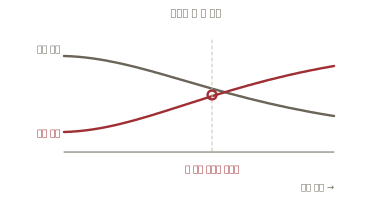
Sleep Comes as the Hands and Feet Grow Warm
Sleep comes as the hands and feet grow warm. The vessels of the hands and feet open to release heat, and the body's core temperature must fall for sleep to set in. When the hands and feet are cold, that window does not open well.
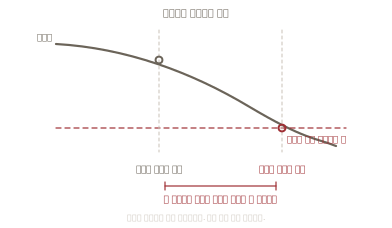
Fatigue Comes Before the Numbers
A test catches something only once it crosses the line dividing normal from abnormal. The thinning of the body's reserve usually happens long before that line, and the body reports it first as fatigue.
The Phone Call the Gut Makes to the Brain
We think the brain commands the gut, but most of the vagus nerve's signals travel up from the gut to the brain. This direction is held within the way that, on a day the belly is uneasy, the mood sinks too.
Inside and Outside the Vessel — The Scale That Divides Water
The water in the body sits on a scale between a force pushing it out (hydrostatic pressure) and a force holding it in (osmotic pressure, albumin). Swelling from poor nutrition is not from too much water, but from a weakened force to hold water in place.
A Sigh Is Not Laziness — It Reopens the Lungs
Before a sigh is a sign of laziness or gloom, it is the body's action of reopening the tiny air sacs that have collapsed under shallow breathing.
Vessels Do Not Narrow Just Anywhere
Some people are told their lipid levels are normal and yet one stretch of artery has thickened. Atherosclerosis does not spread evenly through a vessel; it begins where the artery branches and curves. There the flow breaks up, the wall calls immune cells over, and the macrophages inside the wall take in oxidised lipid until they reach their limit and turn into foam cells. Shear stress and the foam cell are the names for that place.
Why Blood Clots Only Where You Are Injured
Cut a fingertip and the bleeding stops. Yet the same blood, so quick to clot there, does not clot inside the vessel right beside it. The answer lies not with the clotting side but with the side that holds it back. The vessel wall keeps blood from clotting all along, and stops doing that work only where the wall is broken. And the moment clotting begins, the dissolving is already booked.