
Sleep Comes as the Hands and Feet Grow Warm

The short answer
Sleep comes as the hands and feet grow warm. The vessels of the hands and feet open to release heat, and the body's core temperature must fall for sleep to set in. When the hands and feet are cold, that window does not open well.
Contents
When a child begins to feel sleepy, the hands grow warm and the ears turn rosy. Adults too feel their hands and feet grow drowsily warm as sleep presses in. On the other hand, on a night with cold hands and feet, we toss and turn under the covers for a long while. I think this common experience shows exactly how sleep comes.
Sleep Comes When the Body's Core Temperature Falls
We tend to think of sleep only as "the brain switching off." But for sleep to come, something must happen in the body first. The temperature at the body's core drops a little.
The body's surface and interior differ in temperature. The temperature we measure is usually the temperature deep inside the body, the core temperature. This core temperature rises and falls over the day, and around the time of falling asleep it dips slightly. That fall is one of the signals for entering sleep.
The Hands and Feet Are the Window That Releases That Heat
So how does it lower the core's heat? Here the hands and feet come in.
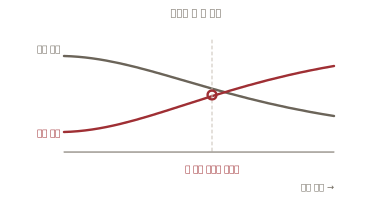
Around the time of falling asleep, the vessels of the hands and feet open. As warm blood rushes to the hands and feet, it releases heat to the outside there. That is why the hands and feet grow warm. As much as the surface (the hands and feet) warms, the interior (core) heat escapes and the core temperature falls. As the temperature falls that way, sleep comes. The hands and feet are, so to speak, a window left open in order to fall asleep.
So the hands and feet growing warm is both the result of sleep coming and, at the same time, the process that brings sleep on.
That Is Why It Is Hard to Fall Asleep When the Hands and Feet Are Cold
Seen this way, the reason people with cold hands and feet find it hard to fall asleep becomes clear. The window does not open well.
When the vessels of the hands and feet do not open well, heat cannot escape to the outside, and then the core temperature does not fall well and the signal for entering sleep weakens. That is why people say, "I'm tired, but my hands and feet are so cold I can't sleep." That soaking the hands and feet in warm water or wearing socks before bed helps sleep come is the same place. Warming the surface opens the vessels, and then the interior heat actually escapes better and the core temperature falls. You warm the surface to cool the interior.
The Structure of Sleep and the Process of Entering It Are Different
Tests that measure sleep look at the time and stages of sleep. But "whether the hands and feet open well around the time of falling asleep so that the core temperature falls well" is not an item those tests measure. That is why "the tests show no big problem, but I'm especially bad at falling asleep" happens. The structure of sleep and the threshold for entering sleep are different stories.
But if your hands and feet are always cold and numb and change color, or if you are so sleepy by day that you can hardly bear it — that may be a signal beyond this story. Care to check circulation and sleep comes first.
We know the coming of sleep only as the eyelids growing heavy. But before that, the hands and feet are quietly releasing heat and cooling the body's core.
A night when cold hands and feet make sleep hard is not from a lack of willpower, but may be the body's signal that the window into sleep is not opening well.
References
- The more the hand and foot vessels open to release heat and the core temperature falls, the faster sleep comes — Am J Physiol Regul Integr Comp Physiol, 2000
- Warming before bed increases heat release and speeds falling asleep — Scientific Reports, 2020
Written by Dr. Heo Ji-young (PhD in Korean Medicine Pathology, Kyung Hee University · former Research Professor of Herbology, Kyung Hee University)
Have a symptom that's been on your mind?
Choose a time on Naver, or send your concerns before your first visit.