
The Force That Springs Back

The short answer
Elasticity is not the ability to stretch well, but the force that springs back after being pressed. This returning force lives in many places — the lungs, the arteries, the skin — and when tissue turns slack or stiff, that back-and-forth grows smaller.
Contents
Pinch the skin on the back of your hand and let go. In a young person, the skin snaps right back the moment you release it. With age, that return slows, and the pinched mark lingers for a moment before it flattens out. This is also a very old method used in clinics to check for dehydration.
I see this "returning force" as an important window into the body. And the more I studied it, the more it fascinated me that this force lives not only in the back of the hand but in nearly every part of the body.
Elasticity Is Not About "Stretching Well"
We often think of elasticity as the ability to stretch well. I see it a little differently. The heart of elasticity lies not in stretching, but in stretching and then returning to the original state.
A good rubber band is good not because it stretches well, but because when you stretch it and let go, it returns to exactly its original length. A rubber band that sags and never comes back stretches just fine, yet it is useless. The body's tissues are the same. Deforming briefly under pressure, then returning to its original tension when the pressure disappears — that back-and-forth is elasticity.
One Property, Found in Many Places
This returning force does not live in only one place.
When you breathe in, the lungs fill and swell; when you breathe out, those lungs shrink on their own and push the air out. A large part of the out-breath is not the muscles pushing, but the force of the lungs stretching and springing back. Each time the heart pumps blood, the large arteries briefly swell and then return, pushing that blood forward. The belly does this too. When you breathe, the way the belly rises and falls is the abdominal wall taking pressure and giving it back.
The lungs, the arteries, the abdominal wall, the bladder, the membranes wrapping the joints, and the skin. They sit far apart and do different jobs, yet they share one and the same property — the force of stretching under pressure and springing back. I do not see these as separate diseases, but as one property showing itself in many places.
Too Slack and Too Stiff Are Both Problems
But this force can be disturbed in two directions.
One is the too-slack direction. When it only stretches and its returning force is weak, it cannot store pressure and give it back. The way the belly does not draw back in as it used to after childbirth is close to this. We often call it "having no strength," but strictly speaking it is not a problem of strength, it is a problem of the returning force.
The other is the too-stiff direction. This time it simply does not stretch at all. It needs to stretch in order to store and return, but if it cannot stretch in the first place, the back-and-forth grows smaller. Tissue stiffening bit by bit with age, and the bladder turning stiff so that even a small amount of urine feels urgent, are close to this.
Slack and stiff look like opposites, but the results resemble each other. In both, the back-and-forth of taking pressure and giving it back has grown smaller.
A Single Photograph Holds Only the Shape
Here we meet the story this book keeps telling.
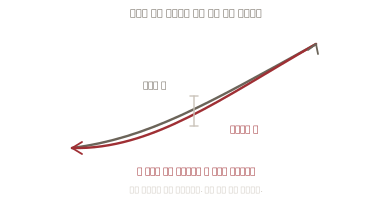
Tests that measure size and shape have a hard time seeing this returning force, because elasticity is not a still state but a moving process. A single photograph captures the shape of the lungs, but not the force of those lungs springing back. That is why "the structure is normal" and "it does not feel as light as it used to" can sit side by side.
Up to here, this is a story well explained by the elastic fibers in tissue, especially a protein called elastin. Tying together the returning force in these many places as one property is the way I have read the body in my clinic.
The Returning Force Can Be Rebuilt
There is one thing I want to say clearly. Just because the returning force has slowed does not mean that is the end of it.
A place that has been stiff for a long time is harder to bring back as it once was, but many of the body's tissues rebuild this force somewhat, in proportion to how much you use and move them. So rather than forcing a stiffened place to stretch, for such patients I look toward gradually widening the returning back-and-forth. Something that suddenly swells, grows hot, and hurts is a different matter from this story; in that case you should see a doctor first.
Pinch the back of your hand and let go once more. Within that brief back-and-forth is the whole of the body's force to withstand pressure and spring back.
If your body is not what it used to be even after a test says "nothing wrong," that is often not a signal that something has broken, but the body's report that its returning force has slowed.
Related Reading
- Where Blood Actually Flows — why a place that stays pressed for a long time hardens
References
- A large part of the force of breathing out comes from the elasticity of the lungs stretching and springing back — the physiology of pulmonary compliance — StatPearls, Physiology: Pulmonary Compliance, 2023
- With age, elastin in the arteries decreases and collagen increases, lowering the arteries' force of swelling and springing back — Arquivos Brasileiros de Cardiologia, 2017
Written by Dr. Heo Ji-young (PhD in Korean Medicine Pathology, Kyung Hee University · former Research Professor of Herbology, Kyung Hee University)
Have a symptom that's been on your mind?
Choose a time on Naver, or send your concerns before your first visit.