
Chuna That Does Not Crack Bones — The Principle of Thixotropic Chuna

The short answer
Does Chuna have to crack my bones? This approach uses gentle, sustained input rather than a forceful thrust to temporarily reduce stiff tissue's resistance; suspected structural injury needs evaluation first.
Contents
Chuna that does not crack the bones — the principle of thixotropic Chuna
"When you get Chuna, don't you crack the bones with a snap?" — I get this question often. The way I work is not that.
The Chuna I do is thixotropic Chuna. It uses the property by which stiffened tissue softens on its own, returning it slowly. The word is unfamiliar, but the principle is intuitive — and, more to the point, it is a property that has actually been measured.
What is thixotropy?
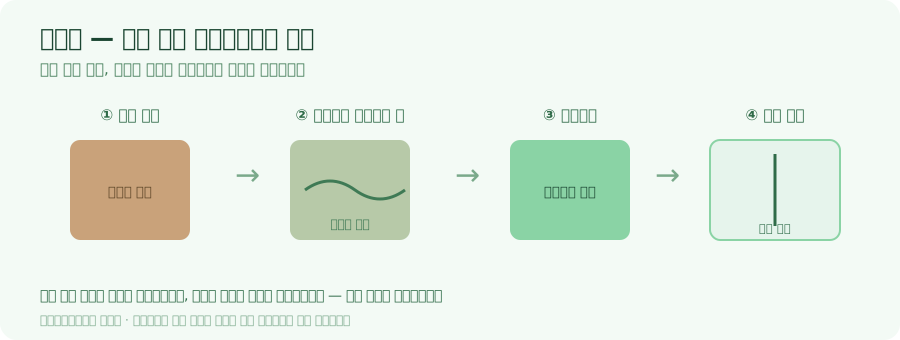
Think of set honey or jelly. Left alone it is firm; stir it slowly and it softens. This property — turning looser when given a stimulus — is called thixotropy.
Muscle genuinely behaves this way. Even a muscle relaxed and at ease develops resistance if left still. Move it and that resistance falls; rest again and it rises.
Why it happens is known too
This is where it gets interesting. This property is not a metaphor — the mechanism is known.
Even inside a relaxed muscle, two proteins — actin and myosin — keep binding a little, spontaneously. These are not force-producing bonds, just bonds sitting there, and they create the stiffness. Move, and they come off; stop, and they re-form at the new length.
There is a study that confirmed it directly in people. In the wrists of twelve people, shaking or applying vibration dropped the muscle's initial resistance by about 19–20%. That said, in the same study, after about 15 seconds of rest most of that stiffness had come back.
This is why you do not have to overcome stiffness by force. Tissue already has a way of softening, and you can take that way.
And it comes back — this is the heart of it
There is a remaining half to this property. Honey sets again once you stop stirring. Coming back is part of what thixotropy is.
In that same wrist study, after about 15 seconds of rest, most of the original stiffness had returned.
So I do not tell you that one release settles it for good. It is not true, and I do not need to say it. It is precisely the coming back that grounds the guidance I give you.
- Why one session does not finish the job
- Why you need to move between treatments
- Why we look at posture habits together
Tissue with a tendency to stiffen keeps trying to stiffen. So correction is not a single event but the work of changing a direction and holding it. (When the correction keeps coming undone — maintenance is half the treatment)
What I hold to in treatment
- A sustained force rather than a momentary one. Tissue needs a little time to soften.
- I look at alignment after the tissue has released. I proceed in the direction the body accepts.
- If anything is uncomfortable during treatment, tell me any time. I adjust the intensity and go only as far as you take in.
Why I do not look only at where it hurts
Feel a stiff muscle and there are two kinds. Stiff because it has no strength, and stiff because it has been used too much. The spot people come in about is usually the latter. Not stiff from laziness — stiff because it never got to rest.
Which raises the next question. Why did that muscle never get to rest? So I do not look only at where it hurts; I look at the body as a whole. (The neck hurts — so why look at the pelvis)
After releasing stiffened tissue and recovering alignment, I go over posture habits and simple exercises so that the state holds — for the reason given above. Left alone, it stiffens again.
This may help if you are
- Someone who felt an adjustment goes back to the way it was soon after
- Someone whose pain keeps returning because of posture or body shape
- Someone who wants to go at the pace the body takes in
- Someone who felt more sore afterward when a stiff spot was pressed hard to release it
I am sometimes asked, "I didn't hear a crack — did it work?" There is not yet evidence that a sound has to occur for the work to have gone well. So I do not make the sound a goal; what I go by is the tissue softening under my fingertips.
If anything is uncomfortable during treatment, please tell me at any time. I adjust the intensity and go only as far as the body takes in.
That said, not all stiffness releases this way. If there is actual structural damage or a sign that needs examination first, I recommend that first.
Chuna is covered by national health insurance up to a set number of sessions per year; I will go over the details at your visit.
References
- In human wrists, muscle resistance fell by 19–20% after stimulus, and most of it returned after about 15 seconds of rest — The Journal of Physiology, 2001
- Comparing 71 people with chronic low back pain against 50 without, sliding between fascial layers was about 20% lower in those with pain — BMC Musculoskeletal Disorders, 2011
- In spinal manual therapy, whether a sound occurred was not associated with pain outcomes (this does not deny the effect of manual therapy itself) — Chiropractic & Manual Therapies, 2022
Written by Dr. Heo Ji-young (PhD in Korean Medicine Pathology, Kyung Hee University · former Research Professor of Herbology, Kyung Hee University)
IF YOU NEED CARE
Have a symptom that's been on your mind?
Choose a time on Naver, or send your concerns before your first visit.