
The Autonomic Nervous System Is Not a Diagnosis

The short answer
If palpitations, digestive discomfort, and cold hands and feet arrive together while every test comes back normal, why is “autonomic” the only name left standing? This name is not a diagnosis — it is a word that tells you where to look. I examine four branches together: the gut, pressure, metabolism, and hormones. Unexplained weight loss, fainting, or a fever that will not go away call for testing first.
Contents
Some patients come to my clinic carrying a list like this.
The heart races, the hands and feet are cold, sleep is shallow, the stomach is often bloated, there is dizziness, sweating for no reason, and constant fatigue.
They have had each item tested, one by one, and received no clear explanation. And somewhere along the way, they have heard the words, "It seems to be an autonomic nervous system problem."
Hearing that often leaves people more at a loss than before. A name has been attached, but it does not tell them what to do.
First, What This Name Actually Means
"Autonomic" is less the name of a disease than a name that gathers up a cluster of suffering under one label.
The body has a regulatory system that runs on its own, without our willing it. How fast the heart beats, how tightly blood vessels constrict and relax, how quickly the stomach and intestines move, how much we sweat, how the pupils widen and narrow — all of this depends on that system.
So when this regulation is thrown off, symptoms from several organs can appear together in one person. This is also why palpitations, stomach discomfort, and cold hands and feet so often appear together.
So this name was not given for a body part — it was given for the situation of the person experiencing it. Even I, who list this very name as my clinical specialty, see it this way.
I Also Look at What Starts Outside the Nerves
This is where I take a somewhat different view.
When people say "my autonomic nervous system is unsettled," they usually assume that the nerves themselves have weakened or become oversensitive. Genuine autonomic nervous system disorders do exist, so I rule out that possibility first. But there are people for whom something remains unexplained even after testing. In these people, a burden that began somewhere else can surface by riding along the nerves.
Something the body did to protect itself rings loudly through the nerves.
When the abdomen is taut, or the chest and abdominal wall do not move well, breathing becomes uncomfortable. When tension is layered onto that discomfort, symptoms such as a racing heart or sweating come along with it. In these cases, it is not enough to look at the nerves alone — I also need to look at the conditions the nerves are responding to.
Is the Alarm Broken, or Is Smoke Coming from Somewhere?
A fire alarm goes off in a house. It might be ringing because the alarm itself is broken, or there might actually be smoke coming from somewhere.
In my clinic, what I encounter more often is the latter. It is not just a problem with the alarm — a burden somewhere in the body is setting it off.
Silencing the alarm and finding where the smoke is coming from are two different tasks.
So along with attending to the alarm, I also check whether there is smoke.
So Where Does the Smoke Come From?
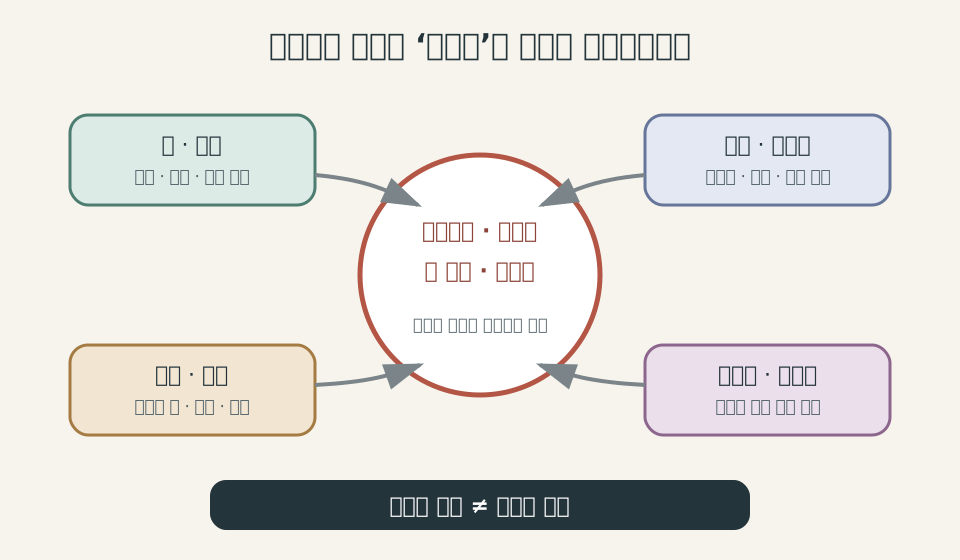
Let me divide what I most often look at into four branches. These four are not the whole picture.
First, the gut. The stomach and intestines are lined with a broad network called the enteric nervous system, and the sensory signals that rise from it feed into the brain. When the stomach and intestines are uncomfortable, that signaling can keep climbing. This also includes cases where gas trapped in the abdomen, or a stomach that does not empty well, pushes up on the diaphragm and makes breathing shallow. I covered this pathway separately in why a tense gut also means a tense mind.
Second, pressure and tightness. When the neck is stiff, the front of the chest is tight, or the abdomen is constantly taut, the body is always exerting a little effort. Even at rest, it is not really resting.
Third, metabolism. When blood sugar rises and falls sharply, when a person has gone without food for a long stretch, or when sleep is lacking, the body reads this as danger. Even if the mind is at ease, the body is on alert.
Fourth, hormones. A woman's cycle, menopause, growth periods, and times when the thyroid shifts. These are times when the baseline range of a hormone itself moves. I discussed how the body defends a baseline in the story of body temperature.
None of these four branches would be called a "nerve disease." And yet the symptoms come out riding on the nerves.
I Do Not Start by Sedating the Nerves
Simply calming the nerve symptoms sometimes does not explain everything. So I also search for where the burden is coming from.
And I choose a direction accordingly. If it is the gut, I look at the movement and sensation of the stomach and intestines. If it is pressure, I look at the movement of the chest and abdominal wall. If it is metabolism, I look at meals and blood sugar fluctuation. If it is hormones, I look at the tests that should be checked first and the living conditions of that period.
Nor do I rely on medicine alone. I sometimes release tightness by hand, and I sometimes address things that come before medicine, such as sleep or meals, first. Wherever there is a place explained by a clear mechanism, I start there.
Why Herbal Medicine Does This Work
These four are linked to one another. A burden in one place grows the burden in another.
In some people, when the mechanical burden in the abdomen eases, breathing becomes easier and they use the accessory muscles of the neck less. It can also work the other way around. When things are linked like this, pushing hard on just one point is not enough.
I separate out the linked conditions and build the formula to match whichever share is largest right now. This is not about replacing the body's regulation — it is about widening the room the body has to regulate itself.
When Testing Comes First
If weight loss is pronounced, if a fever lasts a long time, if there is chest pain or fainting, if strength drops in one arm or leg, or if pain wakes a person at night — there is something that needs checking first. That testing comes before anything else.
This piece is written for those who are still struggling even after that testing has come back with nothing seriously wrong.
If you have been told "it's an autonomic nervous system problem," that phrase is not a statement of cause — it is a statement of where to look.
It means that several of the body's regulatory responses have appeared together. Do not settle on a cause from that name alone — first, rule out the conditions that must be ruled out, then find what has actually overlapped.
Before I silence the alarm, I look for where the smoke is coming from first. I examine, one branch at a time, the places smoke is likely to rise from — breathing, the epigastrium, the gut and the brain, the rise and fall of blood sugar, palpitations, sleep.
Written by Dr. Heo Ji-young (PhD in Korean Medicine Pathology, Kyung Hee University · former Research Professor of Herbology, Kyung Hee University)
IF YOU NEED CARE
Have a symptom that's been on your mind?
Choose a time on Naver, or send your concerns before your first visit.