
My Breathing Feels Tight, but They Tell Me My Lungs Are Normal

The short answer
The chest X-ray is normal, the lung capacity is normal — so why does breathing still feel tight? The lungs have no muscle of their own to expand themselves, so when the rib cage does not open well, breathing feels tight regardless. I sort out which of three sites is involved: the accessory breathing muscles of the neck, pressure pushing up from the abdomen, or how well the chest wall stretches. Shortness of breath even at rest, or bluish lips, calls for testing first.
Contents
- The Lungs Cannot Expand Themselves
- What Keeps the Rib Cage from Opening Fully
- First, Are the Muscles That Open the Rib Cage Already Pulled Taut?
- Second, Is Something Pushing Up from Below?
- Third, Does the Chest Wall Stretch Well?
- And What This Piece Does Not Cover
- I Look at a Different Layer Than the Standard Test
- I Sort Out Which of the Three Is Involved
- When Testing Comes First
"I can't breathe. It feels tight."
Many patients who come in saying this have already been tested elsewhere. A chest X-ray has been taken, lung capacity has been measured, and the oxygen carried in the blood has been checked.
And some of them are told, "there is nothing clearly wrong with your lungs."
Hearing that leaves two feelings behind — relief, and a frustrated so what is this, then. And often the words "maybe it's nerves" follow close behind.
At this point I always think the same thing: a clear lung does not mean comfortable breathing.
The Lungs Cannot Expand Themselves
Many patients find this surprising.
The lungs have no muscle of their own that can expand them.
The lungs cannot open on their own. When the rib cage that holds the lungs expands, the pressure inside turns negative, and the lungs are pulled along with it. The chest opens first, and the lungs follow — the lungs do not exert force to draw the breath in. Breathing is a movement made jointly by the elasticity of the lungs and chest wall, airway resistance, and the breathing muscles.
So there are cases where looking at the lungs alone gives no answer. Even when the rib cage simply does not open well, breathing feels tight.
A chest X-ray and a standard pulmonary function test confirm important disease and the outcome of breathing. But a single round of testing cannot sort out every reason breathing feels uncomfortable. When needed, I look separately at breathing during exercise, the movement of the rib cage, the breathing muscles, and the pattern of breathing.
What Keeps the Rib Cage from Opening Fully
It is not just one thing. It broadly divides into four, and one of the four is not covered in this piece.
First, Are the Muscles That Open the Rib Cage Already Pulled Taut?
The muscle chiefly responsible for breathing is the diaphragm, which crosses between the chest and abdomen. Alongside it are helper muscles, such as the scalene muscles of the neck, which lift the ribs upward.
When these helper muscles are already pulled slightly taut all the time, there is no reserve strength left to pull further when a deep breath is needed. This applies to patients whose shoulders are always raised and whose necks are always stiff.
The phrenic nerve, which moves the diaphragm, also descends from the neck and passes across the front of the anterior scalene muscle. But as I noted in how tension in the back of the neck spreads to the head and the breath, I do not conclude that this nerve is being compressed simply because the neck is stiff.
Second, Is Something Pushing Up from Below?
The diaphragm moves downward when breathing in. It can only move down if there is room to move into.
When pressure inside the abdomen is elevated — when gas is trapped in the abdomen, when the stomach does not empty well, or when the lower abdomen is constantly bloated — it can push up from below. This leaves less room for the diaphragm to descend into.
Patients who say eating makes it feel tighter fall into this group. As the abdomen fills, it pushes up that much more. The problem is in the abdomen, but the symptom shows up in the chest.
Third, Does the Chest Wall Stretch Well?
For the same amount of pulling force, there is a chest wall that stretches easily and a chest wall that is stiff. This is called chest wall compliance. It is not a matter of strength, but of how readily it opens.
This property can decline when the front of the chest is tight, when the abdominal wall is chronically tense, or after a long stretch of hunched posture. Each breath requires more effort than usual to bring in the same amount of air. That is why breathing feels tiring even at rest.
And What This Piece Does Not Cover
Fluid accumulating in the lung tissue also genuinely interferes with breathing. But this should not be brought in as the answer to "breathing feels tight even though the test is normal." It requires examining the heart, kidneys, and lungs together, and is something to be confirmed through imaging and clinical examination.
That is not the story this piece is telling.
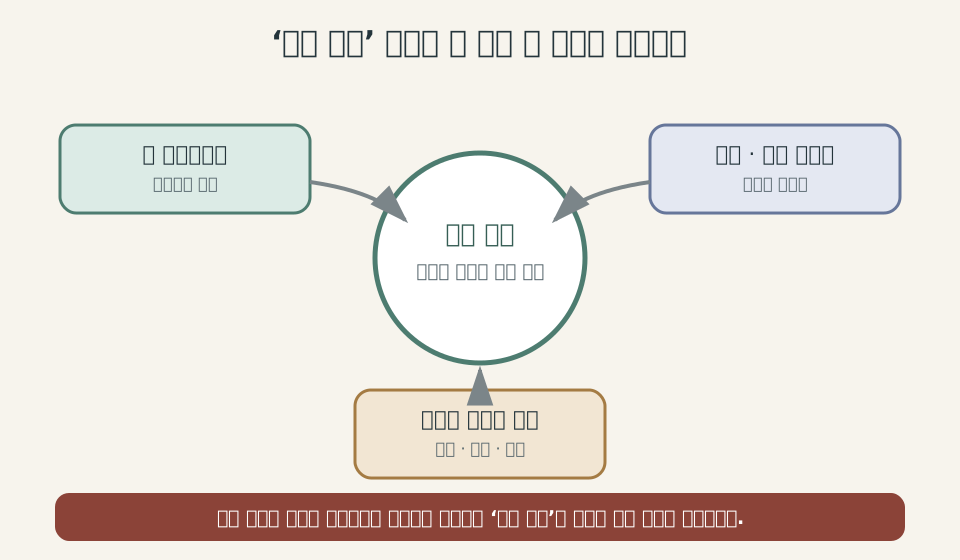
I Look at a Different Layer Than the Standard Test
A standard test result does not record how much the accessory breathing muscles of the neck are being used, or how well the chest and abdomen move in coordination. Not because it cannot be measured, but because it is not what that test measures.
So "the test is normal, yet the chest feels tight" is not, in itself, a contradiction. After first ruling out serious disease, I need to go on and look for a breathing problem at a layer different from what the test was designed to measure.
I Sort Out Which of the Three Is Involved
When what needs addressing is a condition rather than a number, the way medicine is used also changes.
This is not a matter of setting a target number and pushing toward it. I sort out which one actually applies among the accessory breathing muscles of the neck, the mechanical burden coming from the abdomen, and the movement of the chest and abdominal wall.
When I prescribe, I do not automatically fold all three together. I vary the formula to match the conditions actually confirmed in this particular person.
These three are linked to one another. When the abdominal burden eases and the diaphragm is more comfortable, the accessory breathing muscles of the neck are used less. When one place becomes more comfortable, the workload of the neighboring place decreases.
Breathing is a movement that cannot be explained by a single test value alone. That movement is not created by one force but by several conditions together — the elasticity of the lungs and chest wall, airway resistance, the breathing muscles, and posture.
When Testing Comes First
If breathlessness occurs even at rest, if it worsens on lying down so that a person must sleep sitting up, if chest pain comes with it, if the lips or fingernails turn bluish, or if breathlessness began suddenly — there is something that needs checking first. Testing that examines the heart and lungs comes before anything else.
What a lung test confirms is the lungs. It does not confirm how the breath is actually being drawn.
The lungs, the chest wall, and the breathing muscles move together to create a breath. So even for a patient whose chest X-ray is clear, I look at how the neck, chest, and abdomen move.
I use medicine only where I have actually confirmed involvement, among the three.
Written by Dr. Heo Ji-young (PhD in Korean Medicine Pathology, Kyung Hee University · former Research Professor of Herbology, Kyung Hee University)
IF YOU NEED CARE
Have a symptom that's been on your mind?
Choose a time on Naver, or send your concerns before your first visit.