
When the Back of the Neck Stiffens, the Head and Breath Follow

The short answer
A patient comes in for a headache, and pressing on the neck changes the pain. Another comes in short of breath, yet the chest X-ray is clear. Why? Tension in the neck spreads along two branches — head pain and breathing burden. I separate the spark (sleep, meals, heat), the tight spot, and the loop itself. A sudden, severe headache, weakness, or fever calls for testing first.
Contents
- First, This Does Not Start with the Mind
- Why the Back of the Neck, of All Places?
- Here It Splits Into Two Branches
- One Branch Climbs to the Head
- The Other Branch Goes to the Breath
- And Where It Spreads Becomes a New Starting Point
- This Loop Has Three Layers
- Instead of Cutting a Single Strand
- When Testing Comes First
When patients describe where it hurts, the back of the neck is often left out.
And yet, in a patient who has come in for a headache, the pain changes when the neck is moved or pressed. The patient themselves rarely thinks of the neck as the problem — after all, it is the head that hurts.
Patients who come in because breathing feels tight are similar. The chest X-ray is clear, yet the breath is shallow. But when I feel the neck, the muscles along the side are pulled taut.
The two patients' diagnoses may differ. But there is reason to check whether neck tension and breathing are moving together.
First, This Does Not Start with the Mind
Patients often hear, "it's because you're stressed." That is half right and half wrong.
The trigger that tips the body toward tension comes not only from the mind but also from the body's own circumstances.
- Heat — the body is already working to bring its temperature down
- Insufficient sleep — the housekeeping the body needed to do overnight did not happen
- Meals out of rhythm — what the body expected to arrive did not arrive
- Going too long without food — this itself is an emergency for the body
None of these four are purely matters of the mind. Their weight differs from person to person, but all four add a burden to regulation.
So even someone who has been at ease in mind can develop the same symptoms in summer, after working late, or on a day a meal was skipped. They themselves cannot find a reason, because nothing weighed on their mind.
Why the Back of the Neck, of All Places?
When tension rises or breathing becomes more of a burden, the body relies more on the superficial muscles of the neck and shoulders. Conversely, there are reports that in people with chronic neck pain, the strength of the breathing muscles and pulmonary function measures decline together. Which comes first is not fixed. But the two move together.
Here It Splits Into Two Branches
One Branch Climbs to the Head
Pain signals coming in from the neck and signals coming in from the face and head meet at the same relay region in the brainstem. So pain that begins in the neck can feel as though it spreads from the back of the head toward the crown or around the eyes.
Patients call this a headache, even though it did not begin in the head.
The Other Branch Goes to the Breath
Along the side of the neck are muscles that lift the ribs upward. They are called the scalene muscles, and they assist when breathing is deep.
When the superficial muscles of the neck and shoulders are overused for breathing, the neck tires and stiffens more easily.
The phrenic nerve, which moves the diaphragm, also descends from the neck and passes across the front of the anterior scalene muscle. I do not presume the nerve is being compressed. I look instead at how much the accessory breathing muscles of the neck are being used, and how the diaphragm and rib cage are moving.
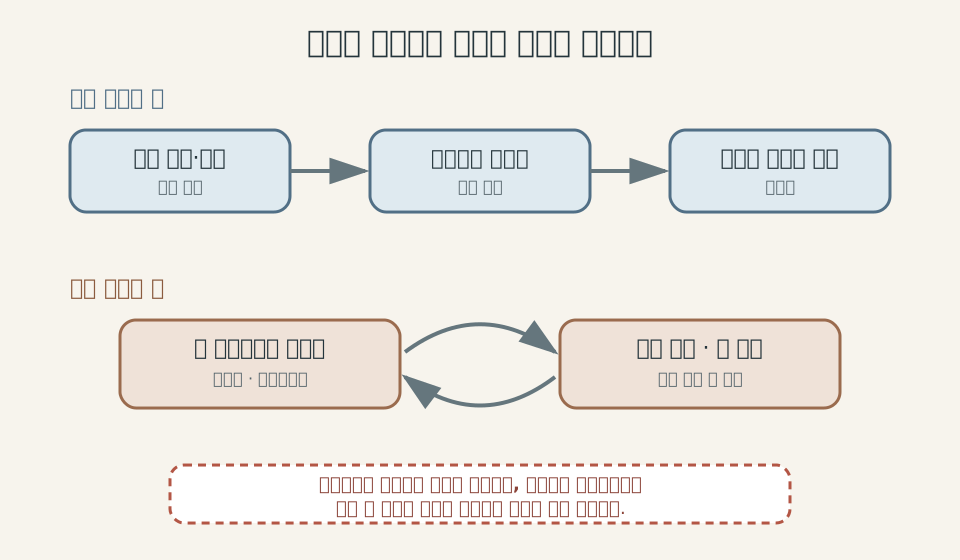
And Where It Spreads Becomes a New Starting Point
When breathing is uncomfortable, the accessory breathing muscles of the neck are used more, and when those muscles tire, breathing can become uncomfortable again.
A loop can form in which neck tension and breathing burden feed each other.
Once this loop has been turning for weeks, it becomes hard to tell what started it in the first place. So the longer a symptom has lasted, the more I look at both where it started and the loop that is now turning.
This Loop Has Three Layers
Working on the head alone, or the neck alone, often does not resolve it.
Even if the neck is released, if living conditions and breathing habits stay the same, the discomfort can return.
The spark. Insufficient sleep, meals out of rhythm, being weighed down by heat. These are conditions that keep the sympathetic nervous system switched on. If this layer stays as it is, whatever is done further up will switch back on.
The tight spot. The neck, the upper shoulders, and the muscles at the side of the neck that lift the ribs. This is both a result of the spark catching and, at the same time, a cause that turns the next revolution.
The loop itself. When shallow breathing deepens even a little, the body feels less of an emergency. Signals to the neck then decrease as well. The speed of each turn slows down.
Instead of Cutting a Single Strand
There are times when working on only one layer is not enough. And the three layers are not always bundled together in every case.
For some patients, the sleep-and-meals side carries more weight. For others, the neck-and-breathing side carries more weight. And there are also patients for whom something else needs checking before this story even applies.
When Testing Comes First
A sudden onset of an extremely severe headache, slurred speech or weakness on one side, a fever with a stiff neck, or breathlessness that does not settle even lying down.
In these cases, the order is different. Testing comes first.
A patient who comes in for a headache and a patient who comes in for chest tightness are telling different stories.
Both may have discomfort in the back of the neck, but that is no reason to assume the same cause from the start. The path the pain has traveled, how much the neck is used while breathing, and sleep and meals — these are three separate branches.
Where a symptom spreads and where it started can be different places. So I do not look only at where it spread, but neither do I invent a starting point I have not confirmed. You are also welcome to start with why "autonomic" is not the name of a disease.
Written by Dr. Heo Ji-young (PhD in Korean Medicine Pathology, Kyung Hee University · former Research Professor of Herbology, Kyung Hee University)
IF YOU NEED CARE
Have a symptom that's been on your mind?
Choose a time on Naver, or send your concerns before your first visit.