
The Store Runs Down First; the Blood Shows It Later

The short answer
With iron, the store runs down first and the blood changes later. So haemoglobin can be normal while the reserve is nearly gone. Medicine built a separate test to see that place.
Contents
The Store Runs Down First; the Blood Shows It Later
"They say I'm not anaemic. So why do I feel this lightheaded?"
When someone says this, I look at the report once more. "Not anaemic" usually means haemoglobin sits inside its normal range. But the iron in the body is not only in the blood.
Iron Sits in Three Places
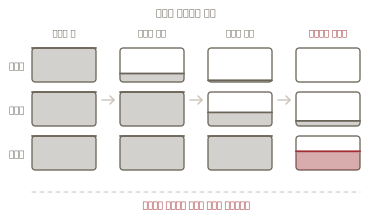
The body's iron is held in three places, broadly: the portion carrying oxygen in the blood, the portion travelling through the circulation, and the portion kept in store in the liver and certain cells.
The body does not draw on these in the same order. When iron runs short, it spends the store first. Meanwhile the haemoglobin in the blood holds steady — as a shop's shelves stay full while stock is being brought up from the back room.
Only after the store is empty does the travelling portion fall, and only then does haemoglobin drop. Shortage begins in the store and ends in the blood.
So "Not Anaemic" Does Not Mean "Iron Is Plentiful"
Here is where a common mismatch arises.
Haemoglobin is, in that sequence, the last value to give way. So a normal haemoglobin means "it has not yet reached the final stage," not "the store is well stocked." A body can struggle while the store is running down.
Some people feel lightheaded, unusually worn out, restless in the legs at night — and are not anaemic. That is when I think of this order.
Medicine Built a Separate Test to See That Place
This is the part of the story I like.
Medicine knew about this. So besides the value floating in the blood, it built a test that reflects the stored portion: ferritin, the protein that keeps iron in store, whose level mirrors the state of the reserve.
So this is not a story about tests failing to see the body. It is a story about having to decide which place to look at before that place becomes visible. Haemoglobin reflects the blood; ferritin reflects the store. They look at different places.
Ferritin has its own complications. Inflammation can raise it regardless of the store. So it is not read on its own.
Which Place Is Thinning
In the consulting room I ask, before "anaemic or not," which place is thinning. Whether the store is running down, whether it has already reached the blood, or whether this is a story about something other than iron.
And a store empties for reasons. Whether little was coming in, whether absorption is poor, whether something is leaking out slowly somewhere. I look at that side too. Filling a store and removing the reason it empties are different jobs.
That said, if stools are black or bloody, if menstrual flow has increased markedly, or if weight is falling without reason — that is beyond this story. Tests to find the cause come first.
"You are not anaemic" is an accurate statement. The place it reflects is the blood.
If you feel lightheaded and are not anaemic, what the body is speaking of may not be the shelves but the state of the back room.
Related Reading
- An Average Does Not Know the Place — which compartment a test looks at
- Fatigue Comes Before the Numbers — tiredness before the line is crossed
Sources
- Iron deficiency begins with depletion of storage iron (ferritin), then circulating iron falls, and haemoglobin declines last — StatPearls, Iron-Deficiency Anemia, 2023
- Serum ferritin concentration is used as an index of the iron stored in the body — WHO guideline on use of ferritin concentrations, 2020
Written by Dr. Heo Ji-young (PhD in Korean Medicine Pathology, Kyung Hee University · former Research Professor of Herbology, Kyung Hee University)
Have a symptom that's been on your mind?
Choose a time on Naver, or send your concerns before your first visit.