
The Body Does Not Age All at Once

The short answer
Cells live for different lengths of time depending on where they are. Some places are replaced within days; others stay as they are for a lifetime. Because that rate of replacement — turnover — differs, age is a single number while several clocks run separately inside the body.
Contents
The Body Does Not Age All at Once
Among people of the same age, one has good skin and another has good knees. It holds within a single person too. The face looks younger than the years while the joints stiffen first — and the other way around as well.
I read this not as a matter of differing luck, but as the body keeping several clocks at once.
Cells Are Replaced at Different Rates in Different Places
The body maintains itself by discarding worn cells and putting new ones in their place. This business of cells stepping back while new ones take over is called cell replacement, or by its usual name, turnover. And the rate of that turnover differs greatly from place to place.
There are places replaced within days — the blood, and the inner wall of the intestine. The outer layer of the skin is on the fast side too. And there are places hardly replaced at all: the nerve cells of the brain, and heart muscle. Cells that, once settled in place, no longer divide in two are called postmitotic cells. In a study comparing 21 human cell types, that range ran from two days to tens of thousands of days.
Taken as a whole, the cellular mass of the body is very nearly replaced within a little over two years. But that is an average, and within it some places have already been rebuilt many times over while others are still running on the originals.
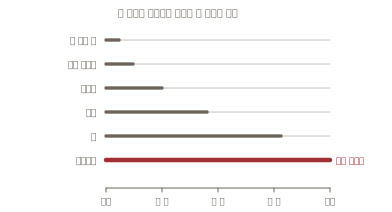
Fast-Changing Places and Long-Lasting Places Face Different Circumstances
This difference is not merely an interesting fact.
Places that change quickly recover quickly. Injure the intestinal wall and new cells rise up within days. In exchange, the replacing itself costs materials and effort, and when materials run short or there is no margin to spare for replacing, it shows quickly. That is part of why the gut and the skin are the first to suffer after someone has eaten poorly or been ill for a long time.
Long-lasting places are the reverse. They are not easily shaken by ordinary demands. In exchange, what accumulates stays. With few chances for replacement, the marks left by the years pile up as they are. Nerves, the heart, and joint cartilage are closer to that side.
Which Is Why a Single Test Does Not Show This Difference
A single test measures today's value. It measures it very accurately. What it does not tell you is which clock that value came from.
A value from a fast clock reflects the state of recent weeks; a value from a slow clock holds the years behind it. The same "normal" can mean, in one case, that things are running well right now, and in another, that some margin still remains. That is how all-normal numbers on a report and the feeling of "not what it used to be" come to sit side by side.
The Fast Places Speak First
In the consulting room I look first at the places that change quickly: the tongue and mouth, the state of the gut, the skin and nails, the hair. Because their turnover is fast, they show the recent state of things first. When the body begins to run short of materials and margin, it shows here first.
Slow places I read the other way. Changes appearing in joints or nerves I take as the story of long-accumulated time rather than of the past few weeks. So they are not a place to hurry a reversal, but a place to change the conditions and wait. Slow does not mean too late. Slow places also improve slowly — and lastingly.
That said, wherever it appears, if a change comes on suddenly, worsens noticeably within a few weeks, or comes with unexplained weight loss — that is not the story of these clocks. Tests to find the cause come first.
We count age as a single number. But inside the body several clocks turn at their own speeds, and within one person some places have already been rebuilt many times.
If, at the same age, one part is fine while another tires first, that is not the body failing to keep pace. It is each place having written down its own time, on its own clock.
Related Reading
- Why Aging Shows First at the Toes — why the farthest places tire first
- The Force That Springs Back — when long-lasting places grow dull
Sources
- About 1.1% of human cells are replaced each day, so the cellular mass of the body turns over roughly every 2.4 years — Tissue Homeostasis and Non-Homeostasis, 2023
- Turnover across 21 human cell types ranges from two days to tens of thousands of days — the heart and brain are maintained by long-lived cells, the outer skin and blood by rapid turnover — Gene expression signatures of human cell and tissue longevity, 2017
Written by Dr. Heo Ji-young (PhD in Korean Medicine Pathology, Kyung Hee University · former Research Professor of Herbology, Kyung Hee University)
Have a symptom that's been on your mind?
Choose a time on Naver, or send your concerns before your first visit.