
The Body Always Builds and Takes Down at the Same Time

The short answer
Bone spends a lifetime being taken down and rebuilt. While we grow, building runs ahead; with age, taking down runs a little ahead. Growth and ageing are not different jobs but two directions of the same one.
Contents
The Body Always Builds and Takes Down at the Same Time
We think of a child growing and an adult ageing as opposite matters — one a making, the other a wearing out.
I take them as two directions of the same job. In the body, building and taking down are always happening together.
Bone Is Taken Down and Rebuilt for a Lifetime
Bone makes this easy to see. It is not a structure made once and left. All through life it is taken down and rebuilt, a little at a time.
There are cells that divide the work: some that strip away old bone, and some that fill the place with new. They work in turn — filling where something was stripped, then stripping somewhere else. So the bone you are using now is not the bone you made as a child.
Taking down is not a fault. Without it, old places would never be renewed.
Only Which Side Runs a Little Ahead Differs
So what is the difference between growing and ageing? Which side runs a little ahead.
While we grow, building runs ahead. Taking down continues all the while, but the filling is the larger share, so bone lengthens and thickens. With age that balance tips slowly the other way. As the share of building cells falls short of what is asked of them, taking down comes a little ahead.
The same two jobs go on, and only which way the scale leans changes. Growth and ageing are not different machines.
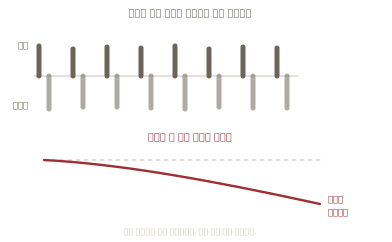
Which Is Why One Snapshot Does Not Show the Direction
Here the story meets what this part is about.
A test measures today's state: how dense the bone is now, how tall you are. From that one value it is hard to tell which side is currently running ahead. The same number could be on its way up or on its way down.
So the space between two tests says more than one test does. Asking to measure again well down the road is about reading the direction, not the value.
The Direction Has Room to Change
I find this picture hopeful. If ageing were a river running one way, there would be nowhere to work. In fact both jobs are still going on, and the balance between them moves somewhat with conditions.
Load through a bone sends a signal to the building side. Eating and sleeping well supply the material and the time that filling requires. That is why I do not tell older patients it is too late. The scale may not be turned over, but the angle at which it leans can change.
That said, if height has dropped noticeably, if a bone has broken from a light knock, or if one spot in a bone keeps hurting — that is a different story from the scale. Being examined comes first.
A growing body and an ageing body are not different machines. Both are building and taking down together; only which side runs a little ahead differs.
So what happens in an older body is not a halt. It means the building is still going on.
Related Reading
- The Body Does Not Age All at Once — different rates of replacement in different places
- Bone Does Not Age as One Piece — bone's state differs from place to place
Sources
- Bone changes throughout the lifespan, with resorbing and forming cells at work together — and resorption outpaces formation as the body ages — StatPearls, Physiology, Bone Remodeling, 2023
- About 1.1% of human cells are replaced each day, so the cellular mass of the body turns over roughly every 2.4 years — Tissue Homeostasis and Non-Homeostasis, 2023
Written by Dr. Heo Ji-young (PhD in Korean Medicine Pathology, Kyung Hee University · former Research Professor of Herbology, Kyung Hee University)
Have a symptom that's been on your mind?
Choose a time on Naver, or send your concerns before your first visit.