
The medicine that does not press the brake for you — following magnolia bark down to its ingredients

The short answer
People come after being told their breathing feels tight but the tests are normal. The lung is an organ; breathing is regulation. Tests look at the organ. The ingredients of magnolia bark do not manufacture a brake that isn't there — they help the brake the body already has work better.
Contents
Some people come saying their breathing feels tight. The tests are normal and the oxygen is normal. And still the sense that there isn't enough air won't lift. Frequent sighing, frequent yawning, a chest that grips. (If you sigh and yawn often and feel there isn't enough air)
To these people I don't leave it at "it's your nerves" — I tell them what is actually turning in the body. And today I want to open one of the herbs used at that spot all the way down to its compounds. Magnolia bark.
First, what is turning
When you tense up, breathing goes shallow and quick. It looks like taking in more oxygen, but what actually happens is different. Carbon dioxide leaves faster than it should.
Carbon dioxide is not only waste — it is the axis that holds the blood's acid-base balance. Let too much of it go and the blood tilts alkaline, the vessels to the brain narrow (hence the dizziness and the fog), and calcium's state changes so that nerve and muscle turn touchy (hence the tingling and the cramps). The body reads this as danger and tenses further; tense further and the breath goes shallow again. The loop closes. (If your hands and feet tingle and cramp but the tests are normal · If you're often dizzy and foggy-headed but the tests are normal)
This loop has more than one starting point. Nerve, breath, vessel, ion, muscle — all of them sit on it. Press one point alone and the loop doesn't break.
What is inside magnolia bark
Magnolia bark's main compounds are magnolol and honokiol. Unfamiliar names, but they are the two most studied compounds in this herb.
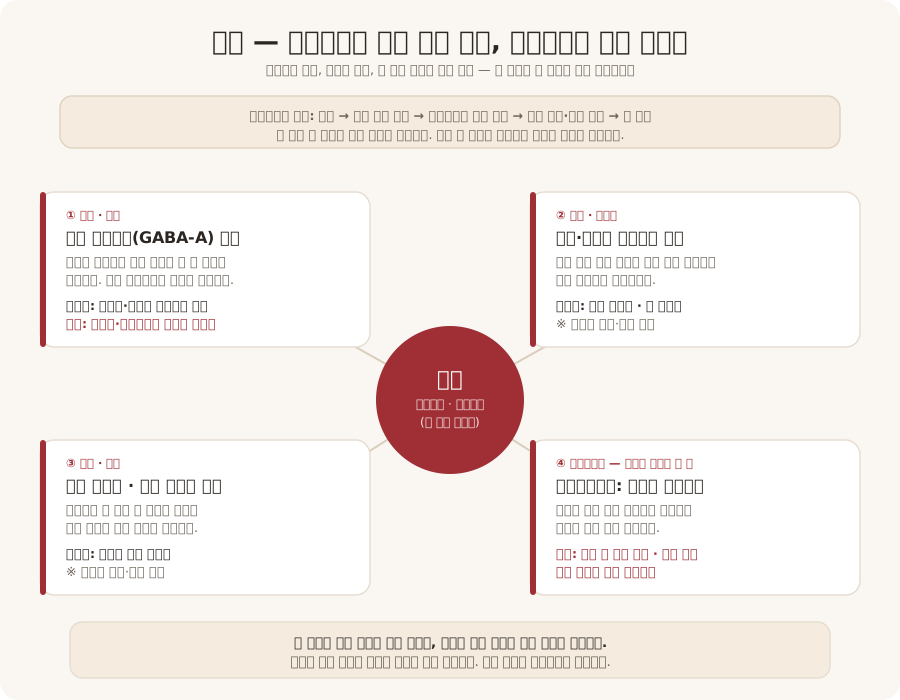
It doesn't build a brake that isn't there — it helps the one that is
The brain already has a device for damping nerves down. A brake on excitation — a substance called GABA, and the GABA-A receptor that receives it.
Magnolol and honokiol attach to that receptor and make the existing brake bite better. In experiments both compounds acted across several forms of the receptor, and in some forms the damping widened more than twofold.
At the amounts we use, these compounds don't press the brake for you. When the body presses its own brake, they sit closer to helping that pressure carry through.
In the same experiment, though, raising the concentration far higher let both compounds open the receptor directly, with no GABA at all. The line between a medicine that helps and a medicine that replaces is drawn by the amount.
The same thing does a different job depending on how much of it there is — that is why I weigh the dose, and it is also why taking an isolated extract on your own is not the same as taking a prescription.
I think the difference is a large one. A medicine that stands in for the body and a medicine that lets the body act and lends a hand are not the same thing. (The medicine that doesn't stand in for your body) Not mending the body, but making the conditions in which the body can mend itself — that is what I mean by self-repair. (What herbal medicine actually does)
Because it is a medicine that helps a brake, it overlaps with medicines that already press one. If you take sleeping pills, anti-anxiety medication or tranquillisers, tell me in advance.
It loosens a tube that has tightened
The second axis is smooth muscle — the muscle that doesn't move at our command, the kind that makes up the gut and the airway. Magnolol slows its spontaneous tightening. For a muscle to contract, calcium has to come in, and magnolol lowers the activity of the channel that calcium moves through (the L-type calcium channel). This has been confirmed in gut muscle.
This is where the fullness in the belly comes down. That magnolia bark has long been used "when the belly is full and stifled" is no coincidence.
There is one more thing I want to add. A text roughly two thousand years old has this line: something feels caught in the throat, and it can be neither spat out nor swallowed. That is the stifling I described in the first paragraph of this piece. And the formula written down for it is called Banxia Houpo decoction — magnolia bark makes up half the name.
That stifling, the kind no test turns up, had already been gathered into one thing by people long ago. I take this less as a sign that the old texts were uncanny, and more as a sign that the stifling itself is that common, and that old. It had no name. It was not a new illness. When stomach and gut are tight the belly distends, and a distended belly pushes the diaphragm up and makes the breath shallow again. (If a full belly leaves your chest tight and fluttering)
That is two points on the loop touched at once.
The same direction has been reported in airway muscle too. In animal windpipe it works through the same calcium channel as in the gut; in human bronchial cells, through a somewhat different one — both toward the muscle letting go. Whether that carries all the way to your breath feeling easier, though, has not been confirmed. There is always a distance between what is seen in cells and what a person feels.
It clears what the loop leaves behind
The third is oxidative burden. Every time the loop of tension and shallow breathing goes round, oxidative stress accumulates. It isn't the loop's cause but its residue — and residue, once piled up, makes tissue touchy on its own and becomes the force that turns the loop again.
Magnolol reaches here too. Reducing oxidative burden, and pressing the central switch that turns inflammation on (NF-κB), are reported together. Confirmed in cells and animals.
It slows the cause while clearing what the cause left behind. Rather than pressing one point hard, slowing several points of the loop together — I take this to be how herbal medicine works.
So, in the consulting room
The reason I name the compounds is that I think you have a right to know what goes into your body. But knowing and judging for yourself are different. Magnolia bark is not used during pregnancy. (Herbal medicine in pregnancy and nursing)
And tight breathing must not all be put down to tension. If chest pain comes with it, or lying down makes you more breathless and your legs swell, or the breathlessness is steadily worsening, the order is different. The hospital comes first. If you live with asthma, chronic lung disease or heart disease, speak with the team looking after that first.
To people who arrive having been told their breathing is tight but the tests are normal, I put it this way. The lung is an organ; breathing is regulation. Tests look at the organ. And the place that is hard for you is the regulation. (What "your tests are normal" actually means)
Medicine doesn't do that regulating for you. What it can do is slow the loop, and make a gap in which the body can find its rhythm again. Making that gap is my part. Finding the rhythm is your body's.
References
- Magnolol and honokiol help the brain's GABA-A receptor and lower neuronal excitation — Neuropharmacology, 2012
- A review of work showing magnolol relaxes gut smooth muscle and lowers oxidative and inflammatory signalling — Frontiers in Pharmacology, 2021
Written by Dr. Heo Ji-young (PhD in Korean Medicine Pathology, Kyung Hee University · former Research Professor of Herbology, Kyung Hee University)
IF YOU NEED CARE
Have a symptom that's been on your mind?
Choose a time on Naver, or send your concerns before your first visit.