
Sleep Is Both Cause and Result

The short answer
“If I could just sleep, I think I’d get better” — is sleep really the place to start? Sometimes poor sleep unsettles the body, and sometimes an unsettled body ruins the sleep. Not being able to fall asleep and waking up partway through are two different things, and where to break the loop differs from person to person. If snoring is joined by breathing that stops, or by severe daytime sleepiness, a sleep study comes first.
Contents
There is one thing that nearly every patient says, after suffering for a long time with discomfort here and there despite tests showing nothing seriously wrong.
"Still, I think if I could just sleep, I'd get better."
When sleep is lacking, pain, fatigue, and breathing discomfort can all stand out more.
But when I hear these words in my clinic, I think something a little different.
Where should the loop be broken?
When Two Things Are Locked Together, an Order Must Be Set
Sometimes poor sleep unsettles the body, and sometimes an unsettled body makes sleep worse.
When the two are locked together, which do you grasp first? This piece starts from there.
The order is not the same for everyone. Sometimes sleep itself must be addressed directly, and sometimes the other conditions unsettling sleep must be examined together with it.
Not Falling Asleep and Waking Up Are Different Things
Both are called "insomnia," but what needs to be asked about them differs. They can also appear together in the same person.
The kind where a person cannot fall asleep at all. They lie down and stay that way for a long while. What is often at fault here is breathing. Lying down changes the burden of breathing, and a body that finds this uncomfortable stalls right at the door into sleep. It is not noticed during the day — only once lying down.
The kind where a person falls asleep and then wakes frequently. Sleep comes, but it breaks often. Here, the larger factor is that the body keeps working even while asleep. Body temperature drops further toward dawn, and some patients wake right around that low point. The fact that no food has come in all night can also overlap with that same window.
And there are cases where the lying-down posture itself is uncomfortable. These patients are not unable to sleep — they are unable to sleep for long stretches. They repeat a cycle of sleeping a few hours, then waking.
So different things are packed inside the same word, "insomnia." What is happening in the body differs depending on whether it is the breathing side, the temperature-and-hunger side, or the posture side.
The Body Does Not Simply Rest While Asleep
Let me note one thing. Thinking of sleep only as a time when the parasympathetic nervous system switches on is off the mark.
But during dreaming sleep — REM sleep — it goes the other way. Heart rate and blood pressure rise again, and their swings grow larger. Sympathetic nervous system activity can actually become even greater than during waking hours. These are figures measured directly in people.
The night is not a time that runs through in a single state — it is a time of moving back and forth between several different states.
So sleep is not a time of rest but a time when regulation keeps working. What was unsettled during the day is unsettled at night as well.
A Signal That Announces the Dark, Not a Sleeping Pill
There is a hormone whose secretion increases when night falls: melatonin. People call it the sleep hormone, but what it does cannot be explained by a single label of "sleeping medication." Melatonin is also a signal that delivers the information that it is now night to the body's clock.
So conditions that blur this signal — bright light late at night, irregular times of falling asleep and waking — can change the quality of sleep. It is not that they prevent sleep outright, but that they push the circadian rhythm later.
So the Order Differs from Person to Person
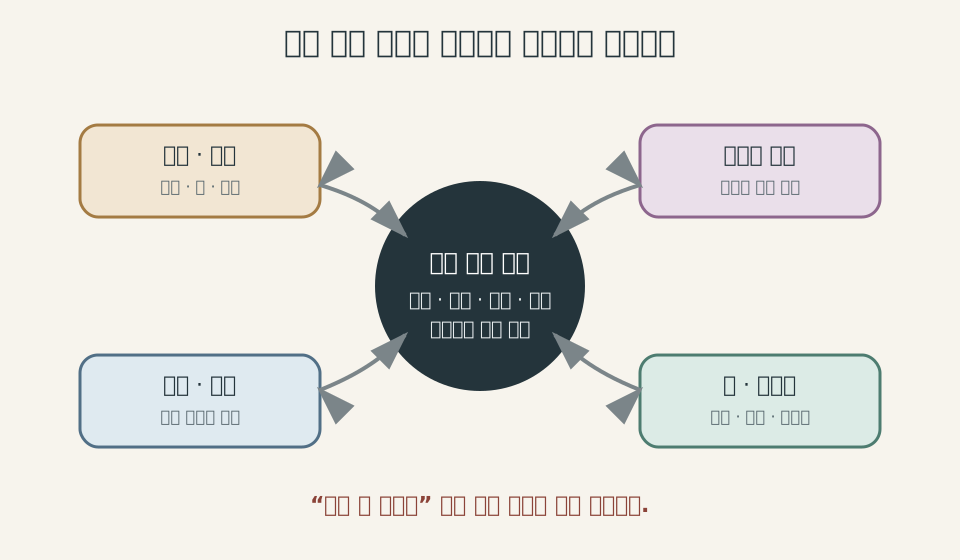
Now I return to the opening question.
If the time of falling asleep keeps drifting later and the daily rhythm has come apart, correcting light exposure and waking time first may take priority. If snoring and breathing that stops are suspected, testing comes first. If pain or breathing discomfort wakes a person every night, that condition is addressed together with sleep.
Conversely, if daytime function and safety are breaking down from a long stretch of poor sleep, there is no reason to put sleep itself off.
If sleep remains unchanged even after several weeks, I do not simply wait because other symptoms have improved. I go back and check whether the initial assumption was correct, and whether there is any overlooked disease, medication, or living condition.
When Testing Comes First
And if you are taking medication to help you sleep, I do not tell you to stop it. A body that has gone without sleep for a long time is itself a danger. At the time it is needed, receiving the help that is needed is the right course.
The words, "I think I'd get better if I could just sleep," are half right.
When sleep returns, several kinds of discomfort can lighten together. But whether sleep comes first, or another condition comes first, differs from person to person.
So I do not consider sleep in isolation, nor do I always put it off. I place sleep and the conditions unsettling it side by side, and look for which loop to break first. This connects to the stories of those who wish to fall asleep without sleeping pills.
Written by Dr. Heo Ji-young (PhD in Korean Medicine Pathology, Kyung Hee University · former Research Professor of Herbology, Kyung Hee University)
IF YOU NEED CARE
Have a symptom that's been on your mind?
Choose a time on Naver, or send your concerns before your first visit.