
The Yellow Powder That Lowers Blood Sugar — Following Berberine All the Way Through

The short answer
More and more people know the name berberine, and many now ask about it first in the clinic. In herbal medicine it is the bitter yellow compound in herbs like Coptis and Phellodendron, and today I want to follow it all the way through.
Contents
More and more people know the name berberine these days. In the clinic, too, it is often the first thing people ask about. In herbal medicine it is exactly the bitter yellow compound found in herbs like Coptis (hwangnyeon) and Phellodendron bark (hwangbaek).
Earlier I worked through gardenia from one end to the other. (The medicine your gut has to switch on) Today I want to do the same with berberine.
It isn't absorbed, and blood sugar comes down
Take berberine by mouth and the proportion absorbed into the body is less than 1%. Almost all of it simply passes through the gut.
Most accounts stop here. "What kind of medicine is it if it isn't even absorbed?"
And yet blood sugar does come down. In a study in newly diagnosed type 2 diabetes, berberine's blood-sugar-lowering was comparable to a diabetes drug (metformin). An analysis gathering the human studies that followed also converged toward fasting blood sugar and glycated haemoglobin coming down.
How does this happen when almost none of it is absorbed? That contradiction is where this article starts.
Let me say this in advance. This is research on a compound — it is not to say that I treat diabetes with herbal medicine. Diabetes must be managed by your attending doctor.
Half the answer is in the gut
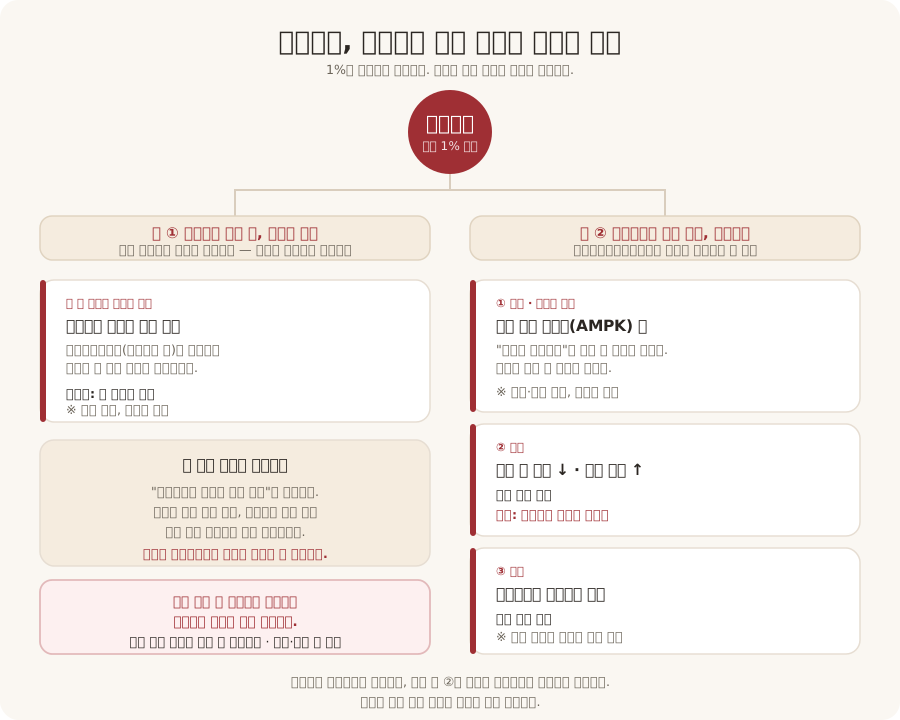
When the bacteria living in the gut convert berberine into a form called dihydroberberine, absorption then rises several-fold. Once absorbed, it turns back into the original form and travels in the blood. In that the bacteria hold the key, this too is a medicine that person's gut switches on. (The same herb, different people, different results)
The other half is more interesting. Berberine does its work without much of it getting into the blood. That is because one of the places it works is the gut itself.
One compound touches several axes at once
This is why I take an interest in this compound.
Berberine switches on AMPK, the cell's fuel-sensing switch. It is the switch that comes on when the body senses fuel is short, and when it comes on the cell pulls in and uses more sugar. At the same time it slows the rate at which the liver makes new sugar, and increases the receptors by which the liver handles cholesterol. And in the gut it shifts the composition of the gut bacteria toward more short-chain fatty acids.
One compound touches four axes at once. Why this matters is that metabolic syndrome is not a disease in which only one axis has given way. Blood sugar, lipids, blood pressure, inflammation and the state of the gut are tangled together and waver together. To turn a state like that back, pushing several axes a little at once is at times better than pressing one axis hard.
This is what I mean by changing the environment. I do not make it the goal to force one sugar reading down. It is a matter of mending the surrounding environment along with it, so the body regains its own capacity to handle sugar. (Eating less but still not losing weight — the place of insulin resistance)
How far this has been confirmed
That absorption is low, that gut bacteria convert it into an absorbable form, that blood sugar and lipids come down in people — this far is confirmed ground. That said, the human studies are not large in scale, and the AMPK and gut-bacteria side of the story has mostly been confirmed in cells and animals.
With a medicine that pushes several axes together, it is hard to draw a clean line around what did what. So there is a great deal left to look at with this one.
So this is how I use it
Because I know these routes, there are a few things I always check when handling a compound like this.
I ask about every medicine you take. Berberine also holds on to the channels by which the body breaks drugs down and pushes them out (the CYP3A4 family, P-glycoprotein). Those channels are also the way many other drugs leave the body, so the concentration of a medicine taken alongside it can rise. Which means "it's natural, so it must be fine with my medicines" is, where this compound is concerned, exactly backwards. If you take blood sugar medication, please tell me beforehand in particular.
I set the amount and the duration, and follow blood sugar alongside. This is not a medicine that works better for using more of it. Past a certain line the benefit stops and only the burden — heartburn, loose stools — goes up. (Is a strong medicine a good medicine?) "Keep taking it until things improve" is not a plan. (When should the medicine be stopped)
I check for the possibility of pregnancy and whether you are nursing. There is a place where this compound is viewed cautiously in relation to jaundice in newborns, so I do not recommend it during pregnancy or nursing, or for newborn infants.
Out of the very property by which this compound binds readily in many places in the body, the benefit and the things to watch for come together. (A medicine's benefit and its side effect come from the same place)
That is as much as is known about berberine so far.
There is a path where the gut has to open the way for it to be absorbed, and a separate path where it works right there in the gut without waiting to be absorbed. Not a sequence — two branches. A single powder, yellow and mild-looking, has this much concrete routing laid under it.
I look at these routes and prescribe from them. Know the route, and you can decide the person, the amount and the duration.
References
- A clinical study in which berberine's blood-sugar-lowering in type 2 diabetes was comparable to metformin — Metabolism, 2008
- An analysis gathering human studies of berberine's blood-sugar-lowering effect — Frontiers in Pharmacology, 2022
- That gut bacteria convert berberine into an absorbable form — Scientific Reports, 2015
Written by Dr. Heo Ji-young (PhD in Korean Medicine Pathology, Kyung Hee University · former Research Professor of Herbology, Kyung Hee University)
IF YOU NEED CARE
Have a symptom that's been on your mind?
Choose a time on Naver, or send your concerns before your first visit.