
A Child's Body Is Not a Scaled-Down Adult's

The short answer
How many times a child's heart should beat to count as normal — even that reference table was for a long time something adults had guessed at. When it was actually measured, it differed. When I see a child, I see not a smaller adult but a body under different conditions.
Contents
"Is it just our child?"
Parents who bring a child in often say this. The child falls ill often, tires easily, reacts strongly to small things — and they ask whether theirs is the only one.
I usually answer this way. A child's body is not an adult's body made smaller.
Even the reference table was an adult's guess
How many times a child's pulse should beat in a minute, how many breaths they should take — even the tables used in hospitals went for a long time without evidence behind them.
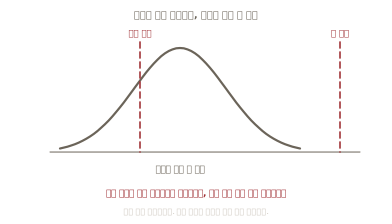
In 2011 researchers gathered the actual records of more than 140,000 children and drew the ranges again. They differed noticeably from the tables in use. The limits of the published ranges fell outside the top and bottom of the real distribution, or ran straight through the middle of it.
In numbers: a newborn breathes about 44 times a minute, and by two years that has fallen to 26. The pulse runs from 127 at birth up to 145 at about one month, then down to 113 by two years.
Within the same child, that much changes across two years. This is why an adult's ruler should not be laid against them.
The structure is still different
They are not only smaller. How far they are built differs.
In a baby under one year the chest wall is about three times more yielding than the lungs. So even in the same position as an adult, what breathing costs is different. (Asleep in Your Arms, Awake the Moment You Put Them Down)
The place where the vessels gather inside the nose is the same. They run shallower than an adult's and break under the same amount of provocation. This is why a child's nosebleeds always come from the same spot. (My Child Gets Nosebleeds Often)
The regulation is still finding its place
The devices that regulate the body do not arrive finished at birth. They settle into place as a child grows.
So in a child, the response of reading a situation in advance and going into readiness shows up more strongly than in an adult. A child whose stomach hurts only on the mornings they have to go to school is not pretending. (My Child Says Their Stomach Only Hurts at School)
The clock is the same. After puberty the hour at which sleepiness arrives shifts later. They have not grown lazy; the body's hour has moved. (No Matter How I Wake Him, He Can't Get Up in the Morning)
Little reserve, so they swing widely
This is the part parents meet most often.
A child holds less in reserve than an adult. The time they can hold a breath is shorter, the time they can go without eating is shorter, and the margin they can carry a short night on is narrower.
So what an adult would have passed over swings a child widely. Being without energy and irritable at the same time comes from here. When reserve falls, the response grows rather than shrinks. (Tired and Yet So Easily Upset)
And for the same reason they come back quickly. A body that swings widely also recovers fast. That is why a child is up and running again soon after falling ill.
Falling ill often is not being weak
What worries parents most is frequent colds. But a child of this age catches colds often because there is still much they have not met. The immune system is building its list. (Since Daycare Started, My Child Has One Cold After Another)
Falling ill often because you are weak and falling ill often because it is the first time are different. What I watch is less the number of illnesses than whether recovery arrives on time.
So this is how I look at it
When I see a child I do not lay the adult standard over them. I look first at how old they are and at what is still settling into place at that age.
The same symptom can mean something different in a child, and what would worry me in an adult can be a passing stage in a child. Sometimes it runs the other way.
A child is a body in the middle of growing. That one fact settles half of the examination.
When to see a doctor first
If a child is not eating and losing weight, if pain wakes them at night, if a fever runs long, or if they have suddenly lost something they could do before — before a story like this, examination and testing come first.
Sources
- A study that gathered the records of more than 140,000 children and redrew pulse and breathing rates by age — they differed markedly from the tables in use — The Lancet, 2011
- An account that children have 6 to 10 colds a year — Korean Pediatric Society
Written by Dr. Heo Ji-young (Ph.D. in Korean Medicine Pathology, Kyung Hee University · former Research Professor of Herbology, Kyung Hee University)
Have a symptom that's been on your mind?
Choose a time on Naver, or send your concerns before your first visit.