
Why the Pungency of Herbs Acts on the Body — The Compounds That Open the Cell's Door
The short answer
Ginger, cinnamon, mint, Sichuan pepper. The taste and aroma of these familiar ingredients are not mere sensation. They are keys that open a "door" in the cell membrane. That door is called an ion channel.
Contents
Why does ginger give a warming feeling in the body? Why is mint cool? Why does the tongue tingle when you chew pungent Sichuan pepper?
I read these familiar sensations less as "taste" than as a signal passed directly between a compound and the body's cells. Today I want to follow that signal to the place where it changes hands.
Cells have doors
Embedded in the membrane surrounding a cell are doors called ion channels. When such a door opens, ions like calcium move in and out of the cell, and that movement itself becomes a signal. A nerve "feeling" something, and a muscle responding, both begin with these doors opening and closing.
Among them is a group called TRP channels. These doors sense temperature and stimulus. Hot, cold, spicy, stinging — a considerable part of what we call sensation comes in through these doors.
And unexpectedly, the keys that open these doors are inside the very herbs we know.
The herb's compound fits into that door
When a compound fits precisely into such a door and makes it open and close, we say it acts as a ligand. It is like a key fitting into a lock. And this is not a metaphor but a binding that has actually been confirmed.
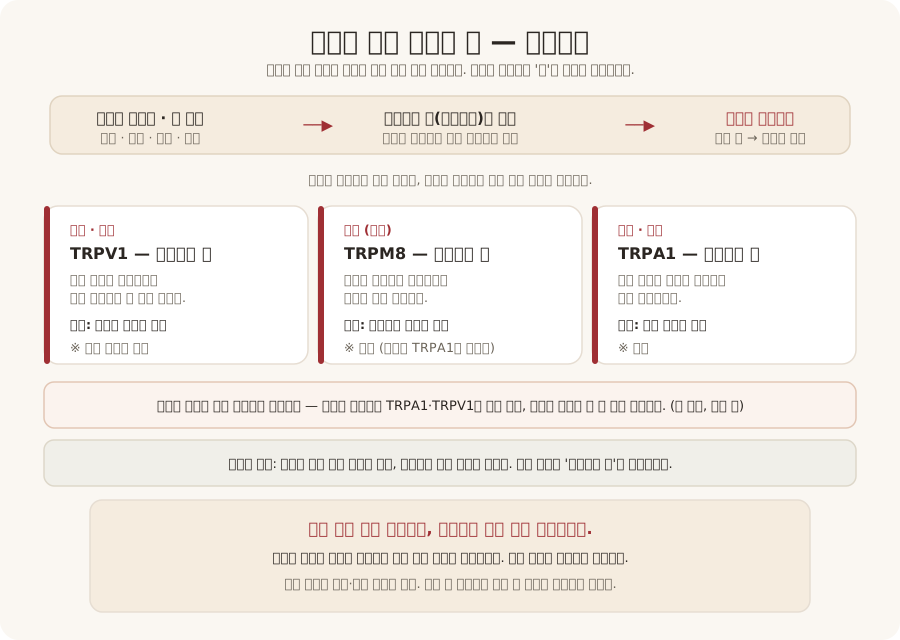
Ginger's pungent compounds, gingerol and shogaol, attach to a door called TRPV1 — the very site where chili's capsaicin binds. That they open it at the same site and in the same way has been shown by work that dug down into the structure of the channel itself. There is a molecular reason ginger feels warming.
Cinnamon's cinnamaldehyde and garlic's allicin open TRPA1, the door that senses stinging. Mint's menthol attaches to TRPM8, the door that senses coolness. The compounds of Sichuan pepper touch both TRPA1 and TRPV1.
The old physicians cannot possibly have known the names of these doors. They sorted the ingredients by sensation — warming, cooling, tingling — and chemistry came along later and attached the reason to the place they had already marked.
Where does this door actually open
There is a puzzling point. The concentration these compounds leave in the blood is very low — not a generous amount for opening a door. (Why herbal medicine works — the paradox of concentration)
So I read this business of doors as a story about where the herb meets the body. The mouth, the stomach and gut, the skin — here the herb has not yet been diluted, and it meets those doors at a concentration high enough to open them. That is the place where ginger warms you on the way down.
What happens after the door opens is another matter. When a single key fits into an ion channel, countless ions pour through it. One signal swells greatly on the inside. But that swelling comes after the key is in, and the amount needed to get it in is a separate question.
One key fits several locks
There is another thing worth noticing. These compounds are not keys that open only one door. Garlic's allicin opens both TRPA1 and TRPV1, and the compounds in Sichuan pepper span the same two. One thing reaches several places at once.
I read this as one layer of the way herbal medicine works in the body. One compound touches several doors, and a single dose contains several such compounds. Rather than pressing hard on one spot, it touches several points a little at a time. (The medicine that wakes at a site turned acidic is another piece of the same picture.)
How far this has been worked out
That the compounds bind to these doors is well confirmed by cell and structural work. Much of it, though, has been seen in cells and test tubes. Whether the same thing happens on the same scale inside the human body — and inside a single dose holding several herbs at once — is still being looked at.
So I don't step straight from "ginger opens TRPV1" to "therefore ginger cures this disease." Between a compound binding to a cell's door and a person's illness improving there are several steps, and those steps differ by person and by condition.
So, in the consulting room
Knowing the names of these doors shows you where they can be used. Someone whose signal runs too high at a stimulus and someone whose response is sluggish need different things attended to. (Why the same diagnosis is treated differently in different people)
Ginger, cinnamon, mint — enjoy them as food, by all means. But taking a particular compound like a drug, in quantity, over a long time, decocted yourself, is not something I recommend. If opening the door is the benefit, opening it too far is a burden. What to use and how much is a thing to set against that person's condition. (A medicine's effect and its side effect come from the same place)
That ginger is warming and mint is cool is not a matter of imagination. It is because compounds actually open and close the cell's doors.
The doors have names, and so do the keys. I mean to know those names and use them.
References
- Structural evidence that ginger's pungent compounds open TRPV1 at the same site as capsaicin — British Journal of Pharmacology, 2019
- A review of herbal and plant-derived compounds that modulate TRP ion channels — Current Neuropharmacology, 2008
- A review of how ginger, menthol, cinnamaldehyde and garlic compounds act on TRP channels — ACS Chemical Neuroscience, 2014
Written by Dr. Heo Ji-young (PhD in Korean Medicine Pathology, Kyung Hee University · former Research Professor of Herbology, Kyung Hee University)
IF YOU NEED CARE
Have a symptom that's been on your mind?
Choose a time on Naver, or send your concerns before your first visit.