
Why Medicine Wakes Up Where It Hurts — What Happens at a Site That Has Turned Acidic

The short answer
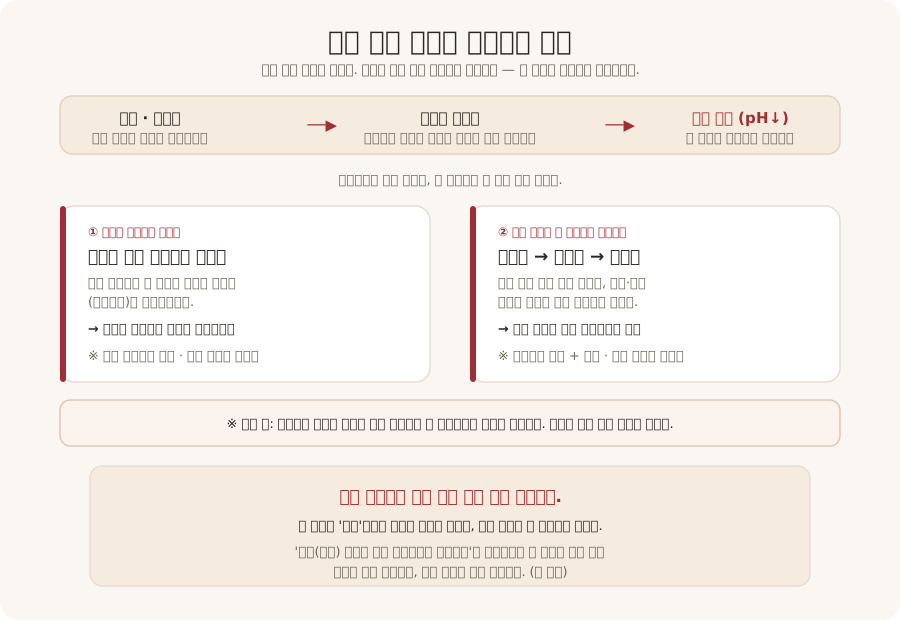
The medicine you take circulates through the whole body. So why does it come undone precisely where it hurts? A site of inflammation turns acidic, and that acidity does two things — it loosens the barrier, and it wakes a locked compound right there on the spot.
Contents
- First, why does a hurting site turn acidic
- The first thing acidity does — it loosens the barrier
- The second thing acidity does — it wakes the locked medicine right there
- But here, there is something that must be stated precisely
- So here is what this means
- What I check in the clinic
- So, what you should not do after reading this article
- Studies I referred to
The medicine you take helps the whole body. Yet its effect shows up at the site that has broken down. In another article I explained the reason this way: "not because the medicine is clever, but because the environment at that site has changed." (The medicine circulates through the whole body, so why does it only work where it hurts)
Today I want to peel back one more layer of that word "environment." A hurting site is, more often than not, tilted toward the acidic. And that single condition — acidity — splits what medicine does into two branches.
First, why does a hurting site turn acidic
Inflamed tissue runs short of oxygen. When cells run low on oxygen, they change how they make energy, and in that process lactic acid builds up. It is the same lactic acid that makes your muscles sting after hard exercise.
So a site where inflammation has lingered tilts locally toward the acidic in its surroundings. This does not mean the whole body becomes acidic. It is just that site — the narrow zone where the problem arose.
These are values measured in human tissue. And this condition, acidity, does the two things I am about to describe.
The first thing acidity does — it loosens the barrier
The epithelium of our body (the surface of the gut, blood vessels, and mucous membranes) is where cells are joined tightly by seams called tight junctions, forming a barrier. When all is well, this barrier does not let just anything through.
But when the surroundings tilt toward the acidic, these seams loosen. In an experiment using intestinal cells, cells placed in an acidic (pH 6.0) environment showed higher permeability than at normal (pH 7.4). The barrier had become loose.
This is a double-edged property. On one side, a needed compound can reach the troubled site more easily. On the other side, if the barrier loosens too much, things that should not leak begin to leak out, and that itself becomes a problem. So I do not settle this as "good/bad." It is a matter of place and degree.
The second thing acidity does — it wakes the locked medicine right there
From here is the part I find most interesting.
When a compound enters the body, the liver and gut do not leave it as is. They attach tags such as sugars or sulfate groups, a processing called "conjugation." Forms with these tags attached are usually inactive — think of it as being locked so the body can excrete it easily. A considerable portion of the compounds circulating in the blood are actually in this locked form.
But at an acidic site of inflammation, this lock comes undone.
One study shows the process concretely. Immune cells activated by inflammation (macrophages) release lactic acid, making their surroundings acidic, and in that acidic environment a deconjugating enzyme (β-glucuronidase) goes to work, so that from the locked compound (quercetin glucuronide) the active substance is released right there on the spot. And that released active substance is precisely what calms the inflammation at that site.
To summarize: the medicine circulates through the whole body while locked, and it opens more readily at a site where there is inflammation. Not because the medicine is clever, but because the key (the enzyme) and the condition (acidity) are both present at that site.
Let me be precise about the subject here. What unlocks the compound is not the acidity itself but the enzyme. The acidity makes conditions in which that enzyme works well. The enzyme is most active in a fairly acidic setting (around pH 4–5), while inflamed tissue does not drop that far (usually pH 6–7). When the conditions are met the reaction speeds up — it is not the simple picture of a switch being flipped.
This connects exactly with what I said earlier. The account of gut bacteria opening a locked compound (The same herbal medicine, so why does it work differently from person to person), and the account of viewing the target not as a single receptor but as the acid-base state of the tissue (Why herbal medicine works — the paradox of concentration) — all are different pieces of the same picture.
But here, there is something that must be stated precisely
This story of "the lock coming undone" contains a mix of what is certain and what is still in dispute. I will not lump the two together.
- That the form locked with sugar (glucuronic acid) comes undone at an inflamed, acidic site is relatively well supported. The study I mentioned above is that case.
- There are also studies that the form locked with sulfate comes undone in tissue to supply the active form, but there is likewise a counterargument that sulfate conjugates do not come undone well at the level of blood vessels. This side is not yet settled.
So to say "conjugated medicine all comes undone where it hurts" is an exaggeration. More precisely: "the sugar-locked form in particular has been confirmed to come undone at a site that inflammation has made acidic." The sulfate side is an interesting possibility, but not yet settled.
So here is what this means
I see these two — the barrier loosening and the locked medicine coming undone — as one layer of what herbal medicine does in the body. Medicine does not do only one thing in one place. It moves on several layers at once. This local action mediated by the acidic environment is one of those layers.
And this layer also explains why benefit and side effect emerge from the same site. (The benefit and harm of medicine emerge from the same place) What wakes the medicine is that acidic site, and what burdens the body when taken too far is the same site.
What I check in the clinic
If the mechanism is like this, there is a prediction that follows. And that prediction must be verifiable in the clinic.
Someone whose inflammation has lingered so long that the tissue has chronically tilted acidic, someone whose barrier is already loose — such people respond to the same medicine with a different grain. So whether it is pain or digestion, I look together at how old the inflammation at that site is, and what the state of the barrier is. Before changing the medicine, I first look at the conditions of the site where the medicine will wake up.
So, what you should not do after reading this article
Just because the mechanism is interesting, do not go out and take a particular compound on your own. How much of a single compound is released, and where, changes entirely depending on that person's state of inflammation, the condition of their gut, and the other herbs used alongside. Because I know this mechanism, I am if anything more careful — I weigh the dose, the duration, and that person's conditions together. Knowing and using arbitrarily are different things.
Studies I referred to
- Review that conjugation and deconjugation are key steps of flavonoid activity (including the point that sulfate conjugates do not come undone well at the level of blood vessels): The flavonoid paradox: conjugation and deconjugation as key steps for the biological activity of flavonoids, Journal of the Science of Food and Agriculture (2012). View original
- The process by which a deconjugating enzyme works at a site made acidic by inflammation, releasing the active aglycone: Mitochondrial Dysfunction Leads to Deconjugation of Quercetin Glucuronides in Inflammatory Macrophages, PLoS One (2013). View original
- Cell experiment showing that acidic pH raises the permeability of the intestinal epithelial barrier: Effect of pH and lipopolysaccharide on tight junction regulators and inflammatory markers in intestinal cells, JDS Communications (2023). View original
That the medicine you take circulates through the whole body and comes undone precisely where it hurts is no mystery. It is because of the condition that that site is acidic. The barrier loosens so access changes, and the locked compound opens right there.
The doors have names, and so do the keys. I mean to know those names before I use them.
Written by Dr. Heo Ji-young (PhD in Korean Medicine Pathology, Kyung Hee University · former Research Professor of Herbology, Kyung Hee University)
IF YOU NEED CARE
Have a symptom that's been on your mind?
Choose a time on Naver, or send your concerns before your first visit.