
What Herbal Medicine Does — Not Working in the Body's Place, but Letting It Repair Itself
The short answer
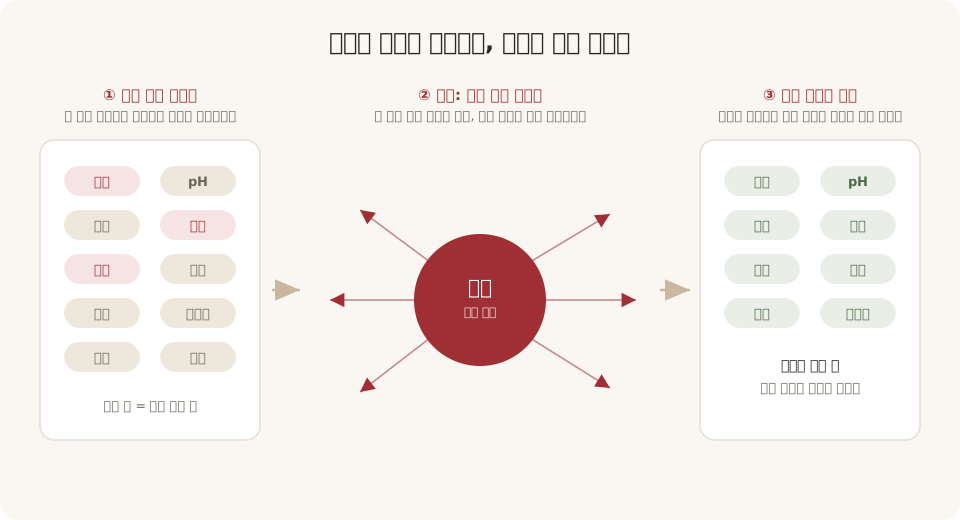
Herbal medicine is not a drug that goes in one door and spreads. Some compounds pass straight through the membrane; some knock on the mucosa's channels on the way past; some ride the gut's nerves straight to the brain. The doors are several, and they open at different times. Set the tilted environment back, and the body does the repair.
Contents
- Disease does not arise from a single cause
- The body's environment is not one thing but several axes
- What is different about herbal medicine — it does not press one spot hard
- But "how does it reach" is the harder story
- The closest picture I can offer
- To give one example — even licorice alone touches several systems
- The repair is done by the body
"What on earth does herbal medicine do in the body?" — I am asked this often. It is a good question. It is hard to reduce to one sentence, because the body is not that simple. But the thought I hold onto in practice is clear. Herbal medicine is not a medicine that swaps out a broken part; it is a medicine that returns the environment to a state in which the body can repair itself.
Disease does not arise from a single cause
First, I want to clear up one misconception. I do not claim that "disease arises not because a part has broken but because the environment has changed." There are diseases that do arise because a part has actually broken. Tissue is damaged, cells die, organs fail. In those cases, the treatment suited to that comes first.
Yet what I meet far more often in the clinic is the case where the part is fine but the environment it sits in has changed. People whose tests come back normal but who keep hurting, in whom several symptoms arrive together, and for whom medicine works only for the moment. And even where there is real damage, what enlarges that damage and blocks recovery is usually the surrounding environment. So I do not treat part and environment as an either-or; I look at them together.
The body's environment is not one thing but several axes
I use the word "environment" broadly. The environment inside the body is not set by any single thing. It is set by many conditions meshing together at once.
| Axis | What it deals with |
|---|---|
| Physical | Pressure, tension, shear; the stiffness and flow of tissue |
| Time | How fast (rate), how long (accumulation) |
| Chemical | Acid-base (pH), ions, electrolytes |
| Metabolic | Energy, insulin, mitochondria |
| Immune | The baseline of gut mucosal immunity and systemic inflammation |
| Nervous | Regulation of the autonomic and vagus nerves |
| Endocrine | The rhythm and feedback of the hormone axes |
| Circulatory | Blood and lymph flow, the clearing of waste |
These axes stand side by side. None of them plays the boss. There are diseases in which pressure matters, but there are also diseases in which pressure hardly appears and immunity and metabolism give way first. The axis that tilts first differs from disease to disease, and when one tilts, the rest are shaken in a chain. That is why a disease with the same name has a different site to mend in each person.
What is different about herbal medicine — it does not press one spot hard
Here the character of herbal medicine shows. A medicine that presses one target hard with one compound does move that one axis, and reliably. It is exactly the method needed when it is needed.
Herbal medicine has a different grain. Within a single packet are tens, hundreds of compounds, and they act a little on several axes at once. One touches acid-base a little, one the gut's immunity, one the blood flow, one the excitability of a nerve. Even where it does push one spot hard, it is a way of not leaving it at that one spot but returning the whole tilted environment together toward its original range.
This is not a thought I came up with. The old medical texts composed a prescription as sovereign, minister, and assistant. And when a prescription grew large, they wrote this down — one sovereign, nine assistants. To enlarge a prescription was not to add more hard pushing but to add more hands helping from alongside. They had set even the ratio, two thousand years ago.
But "how does it reach" is the harder story
The axes above are where the medicine lands. Which leaves the question of how it gets there.
There is a common picture — you swallow it, the gut absorbs it, it rides the blood to the target. I take that picture to be one route among several. In practice it forks.
- Some compounds never touch the blood. Things like the volatile oils pass straight through the oily membrane around a cell. A route with no absorbing and no carrying in it at all.
- Some knock on the doors (channels) of the gut's mucosal cells on the way past. Not absorbed yet, and the signal has already gone.
- Some signals ride the gut's nerves straight up to the brain. No blood involved. When your stomach eases the moment you take something, there is a route like this behind it.
- Some arrive locked, and gut bacteria have to open them before they are active. A well-known route — and one among several.
- Some never reach a target at all and only change the environment. Mending the large bowel's conditions so the mucosal cells recover, for instance.
There isn't one door. And here is what matters — these routes don't open at the same time. One opens in the mouth within minutes; one hours later in the gut; one works over days. And they touch each other. A route that opened first changes the conditions the later ones arrive into.
So herbal medicine's action can't be drawn as a line, or as a fan. The doors are several, the timing is staggered, and they interfere with one another.
The closest picture I can offer
You have probably seen the big-ball roll at a school sports day.
Several people get their hands on a huge ball and push. Each hand lands somewhere different. One pushes low, one from the side, one high. The directions differ too. The hand pushing from the side is pushing the ball sideways — taken on its own it looks wrong. The force isn't equal either. Some push hard; some only steady it.
And the ball rolls one way.
What herbal medicine does in the body is close to this. Each compound lands somewhere different, arrives at a different time, pushes in a direction and with a force that isn't shared. Take any one of them out and ask "what does this do," and the answer comes out strange. It is like watching only the hand that pushes sideways. The hands have to gather for the ball to roll.
And the old prescription rule shows up again here. One sovereign, nine assistants — keep the hard-pushing hand to one and add hands that steady. Composing a prescription was deciding which hand goes where, and how hard it pushes.
This is why I don't use a see-saw picture. It isn't a structure where one side rises as the other falls. A see-saw has one axis and two directions; what happens in a body doesn't tidy up that way.
And here is the genuinely hard part. The same compound at the same site responds differently according to amount. Calcium inside one cell is poison in excess and collapses function when short. It differs by how many receptors are on the receiving side, and how sensitive they have become. It differs by how much blood reaches that spot, and what state the mucosa is in.
The route the medicine takes, the body's environment, and the body's response — none of the three runs on its own.
This is why herbal medicine, for all that it does well, is hard to use well. It isn't a medicine you can use by memorising a list of compounds. You have to see where the ball is sitting now, and decide which hand goes where.
Each of these pieces is what pharmacology deals with. Joining them into one picture — "returning the environment" — is still a work in progress.
To give one example — even licorice alone touches several systems
This may sound abstract, so let me take a single herb as an example. Licorice.
It is not a random choice. The ancients called licorice "the elder of the state." They set down what they meant by it — the one who is not the sovereign, yet whom the sovereign defers to. A place that levels the whole board without going out in front itself.
That is not vague praise. Licorice works on three different layers.
In the decoction pot — before it has even entered the body, it affects how the compounds of the other herbs boiled with it are drawn out.
At the gut mucosa — it settles the mucosa, and so levels the very process by which the other herbs are absorbed and metabolised.
At nerve and muscle — it presses on the door calcium comes in through and restores the potassium balance, damping down symptoms that rise in a hurry.
The layers differ, the timing differs, and they touch one another. When licorice changes another herb's absorption, that herb's action changes, and then the conditions at the place licorice sits change in turn. It is not that one side only pushes the other — they give and take.
This is why licorice goes into so many prescriptions. Not because it is mild, but because it levels the board so the other herbs can do their work properly.
What this article is saying, the ancients had entrusted to a single herb. So licorice is not a "mild herb." It genuinely acts on several systems at once.
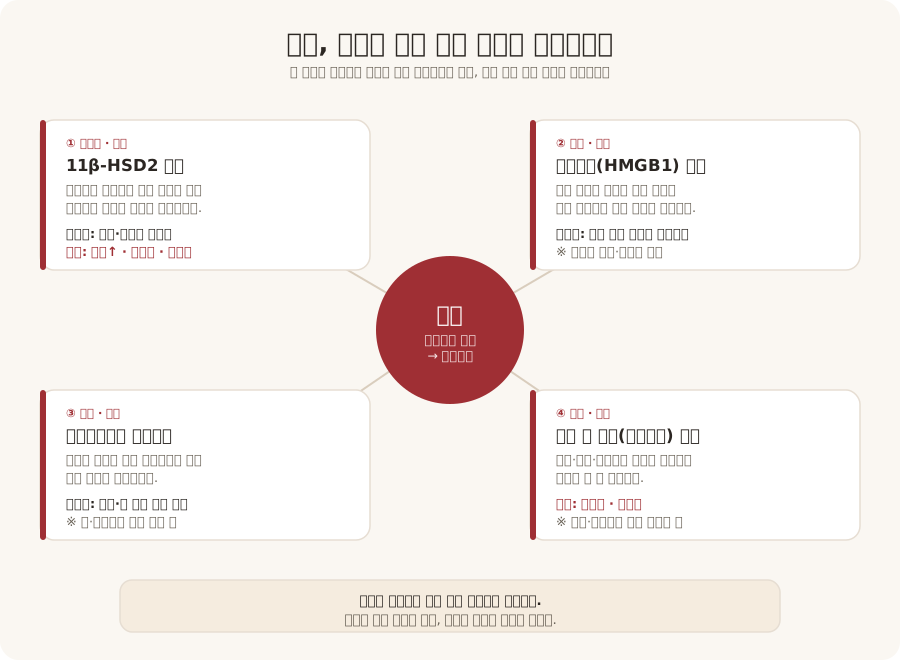
Even a single herb spreads out in this many directions. That is why there is no herb that is only good, and none that is only bad. The same action helps one person and burdens another. That licorice, used long and in quantity, can raise blood pressure or drop potassium comes from the same source. This is why a Korean medicine doctor composes the medicine differently for each person and weighs both the dose and the duration.
The misconception of the "mild herb" is not the fault of the old texts. The old medical texts drew lines around licorice too — do not use it for this kind of person, do not use it together with these herbs. They never wrote that being mild meant it could be used any which way. (Herbal medicine has side effects too — the licorice story) If you take blood-pressure medicine or a diuretic, or have heart or kidney problems, please tell me beforehand.
The repair is done by the body
Here is the heart of it. It is not the herbal medicine that heals the disease. The herbal medicine returns the environment; the actual repair is done by the body itself.
Cells have, from the start, their own devices for repairing themselves. They clear away the worn parts, close wounds, and re-set a shaken balance. But it is known that these devices grow sluggish with age, or under prolonged overnutrition and inflammation. If that is so, then returning a tilted environment within range leaves room for those devices to do their part again. This is what I mean when I say I do not work in the body's place — I help it.
That self-repair declines when the environment worsens is known. But there is as yet no human data showing that returning the environment with herbal medicine sets those devices turning again. That connection is a thought I hold from clinical practice.
Nor does this approach fit every disease. There are clearly cases where a part is badly broken, where life is acutely threatened, where surgery or a strong drug must come first. Herbal medicine does not replace such treatments. When that is needed, I recommend tests and other care first.
And returning the environment takes time. It does not change dramatically at once; it is a process in which the tilted axes find their places one by one, and I aim to reduce the medicine as things improve, so that in the end the body stands on its own without it.
This too is not a principle I set. The old medical texts fixed in advance how far to go with medicine. With a strong medicine, to six parts in ten; with a mild one, to nine in ten at most. None of the three is ten. And they added this — do not overdo it; you will injure what is sound. The remainder was to be handed over to food and to the body.
That medicine does not work in the body's place is not something I am saying anew — it is a two-thousand-year-old rule of prescription.
To the question of what herbal medicine does, I answer: it returns the body's several environments together so the body can repair itself. Shortened, the sentence loses much, but the direction at least is clear.
The one who heals is the body, and the medicine is a helper that makes the conditions for it. Which axis those conditions are tilted on right now — let us look for it together.
References
- A review of how the compounds in herbal medicine regulate many biomolecules at once rather than a single target — BMB Reports, 2022
- A review of how baicalin from Scutellaria and the ginsenosides of ginseng are turned into active forms by gut-bacterial metabolism — Frontiers in Pharmacology, 2023
- A review of how licorice alone engages both the enzyme handling electrolytes and blood pressure and the inflammatory pathways — Frontiers in Endocrinology, 2019
Written by Dr. Heo Ji-young (PhD in Korean Medicine Pathology, Kyung Hee University · former Research Professor of Herbology, Kyung Hee University)
IF YOU NEED CARE
Have a symptom that's been on your mind?
Choose a time on Naver, or send your concerns before your first visit.