
The Same Back Pain, With a Different Cause, Calls for Different Treatment — The Three Branches of Pain

The short answer
Why can the same back pain need different care? Muscle, joint, and nerve-related pain can show different patterns; foot numbness or leg weakness needs imaging first.
Contents
Even the same words, "my back hurts," reach me as three different questions.
When treating back pain and neck pain, before "where does it hurt" I first separate "why, and from where, did this pain come." Because when the cause differs, the location where I place the needle, the composition of the pharmacopuncture, and the order of treatment all change. In this article I will explain, with an illustration, the perspective of dividing pain into three branches.
The Same Pain Can Come From Three Branches
The cause of long-standing pain comes largely from three structures. The character of the pain and the situations in which it hurts differ from one another.
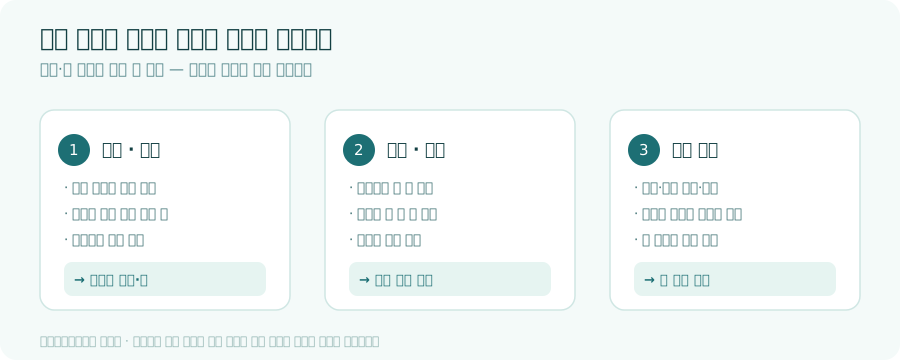
1) Pain from Muscle and Fascia
This is most common in occupations that involve sitting or standing for long periods. The whole back feels stiff and achy, and there are several tender points that hurt when pressed. A distinctive feature is that moving actually loosens it a little.
For this type, I approach by finding the tender points and needling them so that the contracted muscle fibers relax, and by delivering pharmacopuncture directly to areas where circulation has declined.
2) Pain from Joint and Ligament
The pain concentrates when bending the back backward or tilting to one side. A frequent pattern is that the back does not straighten well when standing after sitting a long while, but loosens a little after walking briefly.
The area around the joints has a sparse distribution of blood vessels, so recovery substances do not reach it well. For that reason, I approach by using pharmacopuncture at the acupoints around the joint and at the ligament attachment sites to reduce this limitation.
3) Pain Involving the Nerve Pathway
Along with the back pain, numbness or a pulling sensation extends into the buttock, thigh, and calf. Often it worsens when sitting and eases when lying down.
For this type, I frequently combine acupuncture treatment rather than pharmacopuncture alone. However, if the numbness descends all the way below the foot or the leg loses strength, I first recommend confirming the degree of nerve compression with an imaging test.
That Is Why I Separate the Cause From the First Visit
Outwardly the three types are the same "back pain," but the starting point of treatment differs. So at the first visit I carefully check the character of the pain, the location of tenderness, the direction and extent of numbness, and body posture, to gauge first which type it is — or whether several types overlap. Only by starting from separating which branch it is does the place to work on become visible.
References
- Tender points in the fascia that wraps muscle are what produce the aching — Seoul National University Hospital
- Tendons and ligaments are poorly supplied with blood, so they heal more slowly than other tissue — Frontiers in Physiology, 2015
- If numbness runs down to the foot, or the ankle and toes weaken, a nerve may be compressed and should be checked — Asan Medical Center
Written by Dr. Heo Ji-young (PhD in Korean Medicine Pathology, Kyung Hee University · former Research Professor of Herbology, Kyung Hee University)
IF YOU NEED CARE
Have a symptom that's been on your mind?
Choose a time on Naver, or send your concerns before your first visit.